“That’s it, she’s a goner” is the typical media response to the Susie Wiles interview for Vanity Fair, part 1. But a week later, she’s still there. A deep dive into why reveals surprising relationships and an unexpected power interaction with implications for the future of this chaotic administration.
Susie Wiles, White House Chief of Staff and Trump’s 2024 campaign manager, formerly worked for Ron DeSantis before crossing over to Trump. She worked her way up to the top echelons of the Republican Party and, along the way, earned an impressive reputation among the party’s movers and shakers. The first thing former Republicans and never-Trumpers will tell you about Susie is that she is the only person in the current administration who is actually qualified for the position she holds. That includes the narcissistic dimwit sitting behind the desk in the Oval Office.
Dana Bash noted in a CNN YouTube short, December 16:
2:05: [She’s] so under the radar, you might not have ever heard of Susie Wiles, and there’s a reason for that. She doesn’t like to be in the public, and now, splash – she’s right in the middle.
That Susie Wiles suddenly emerged from the obscurity of behind-the-scenes leadership into the high-profile spotlight of a Vanity Fair feature article was not due to any external pressure. When writer Chris Whipple requested an interview, Susie didn’t hesitate to agree. She didn’t need to be persuaded, and it wasn’t that she didn’t know of Whipple’s work or Whipple himself. They’d been on mutually respected terms of acquaintanceship since the 1980s. For a woman described as “very strategic and very sharp”, this was unquestionably an intentional decision.
The first of a series of hour-long interviews began in February 2025. Eleven interviews later, the first feature article was published and instantly created a media firestorm.
Both right-wing and left-leaning media thought she was on her way out the door, given her stark criticism of the leading lights around Trump, and of Trump himself. Among them were such disparaging assessments as:
Trump has “an alcoholic’s personality” and governs with the mindset that “there’s nothing he can’t do. Nothing, zero, nothing”. (BBC)
“He wants to keep on blowing boats up until Maduro cries uncle,” Wiles said. (CNN)
Vance’s conversion to support Trump had been “sort of political” and he had been “a conspiracy theorist for a decade”. (Financial Review)
Russell Vought, budget tsar and arch-conservative policy architect, is “a right-wing absolute zealot” (Financial Review)
She said that Attorney General Pam Bondi “completely whiffed” her handling of the Jeffrey Epstein files. “First she gave them binders full of nothingness. And then she said that the witness list, or the client list, was on her desk,” Wiles said. “There is no client list, and it sure as hell wasn’t on her desk.” (CNN)
Wiles also said there was no evidence in the files that Bill Clinton visited Epstein’s island at all, let alone “28 times,” as Trump has claimed. (Financial Review)
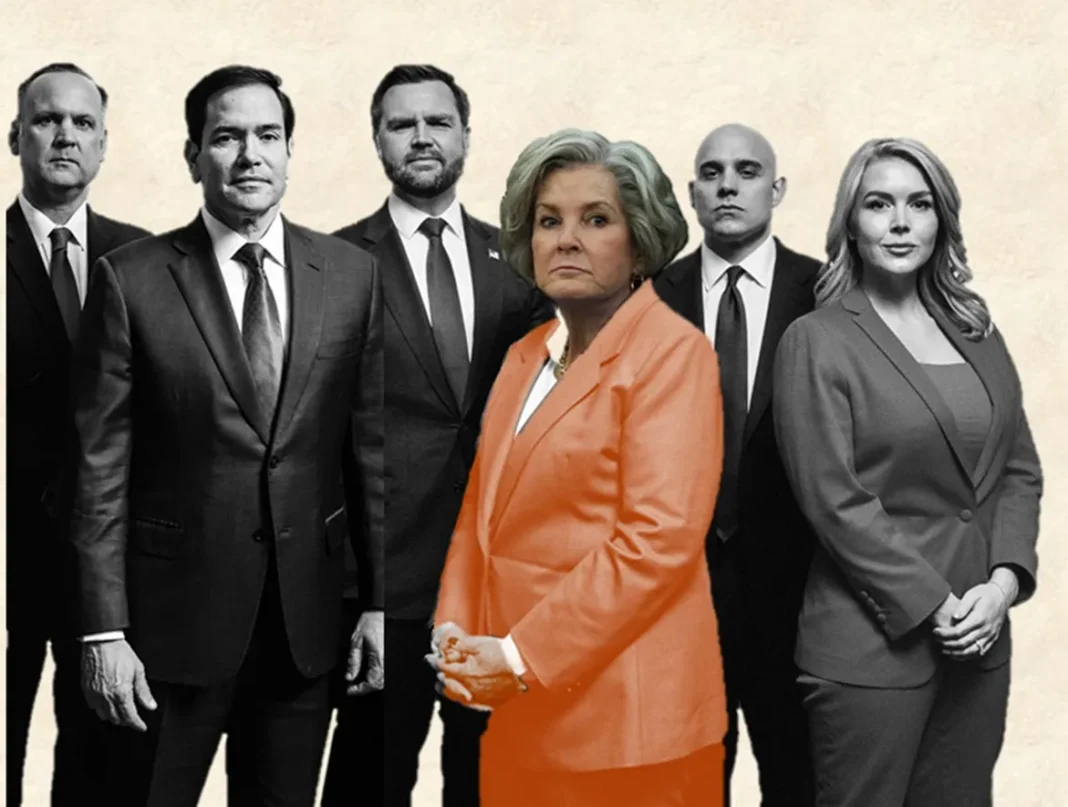
However, those who predicted her professional demise via prompt resignation or presidential firing were quickly proven wrong. Given the declarations of overwhelming support from her “core team” (JD Vance, Marco Rubio, and Stephen Miller) and their satellites (Russell Vought, Pam Bondi, Caroline Leavitt, and the deputy chiefs, Dan Scavino and James Blair) at the White House, Susie Wiles wasn’t going anywhere.
Chris Whipple was Rick Wilson’s guest on a podcast that aired on December 20. He explained that initially, he’d approached Wiles for an interview about her experience as Trump’s campaign manager.
1:38 Chris: It began because I was writing a book and still am on the history of presidential campaign managers from 68 to the present. Uh, and Susie Wiles is gonna be a major character in that. We began talking about presidential campaigns, and it very quickly became clear to me that she really wanted to talk about Trump 2.0 during our first conversation.
2:20 Chris: I came back to her a few months in, and I said, “Guess what? Vanity Fair wants to do a big takeout on the White House, uh, Trump 2.0, and your role in it.” And she was all in. And remarkably, as everyone knows by now, she was on the record almost the entire time except for moments when it was mutually agreed that we would go off the record. And those moments were very rare.
Following the publication of the Vanity Fair interview (part 1), Whipple was initially set back by Wiles’ response, given her very open cooperation over the ten months of interviews. But her reaction, though not honest, was predictable. She had to provide a sop of some kind to those feeling the sting of her criticism.
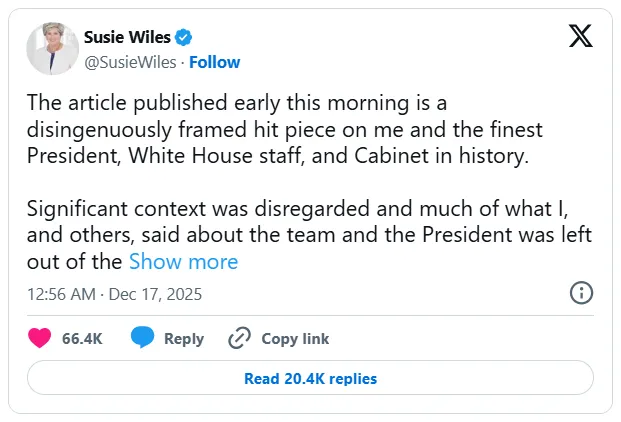
We don’t need to show more for you to get the gist of Wiles’ response. It was performative and worked as intended. That is to say, it instantly placated Trump and lulled all those in Susie’s orbit back into their comfort zone around her.
This is a significant data point in the dynamics of the White House administration. Susie Wiles is the central authority figure, not because she conspicuously wields power, but because she is the voice of intelligence, organised practicality and, above all, calm. She is the grown-up. In a space where ambition, superegos and professional anxiety are constantly bumping up against each other, Susie Wiles is the cool head in the room.
This is evident in the reactions of those around her.
In an interview with The Washington Post on December 16, Trump said he wasn’t offended by his subordinate’s word choice and that he has confidence in Wiles to continue in her role.
“Sometimes I am a conspiracy theorist,” Vance said, “— and by the way, Susie and I have joked in private and in public about that for a long time.” (The Washington Post)
Pam Bondi also toed the line for Wiles, calling her a “dear friend” who “fights every day to advance President Trump’s agenda — and she does so with grace, loyalty, and historic effectiveness.” (The Washington Post)
In an X post, Russell Vought wrote: “Susie Wiles is an exceptional chief of staff.”
These are brief excerpts. The full quotes are overflowing with effusive praise and absolute trust, all of which speaks to their reliance on Wiles. The underlying message is that they’re far more panicked by the thought of her leaving than by anything she said to Chris Whipple.
It is also evident in Chris Whipple’s observations of Susie’s interactions with other power centres in the White House. Rick Wilson asks him to talk about how different Trump 1.0 is from the current term.
5:15 Chris: Oh, it’s night and day in the White House at least. There’s still plenty of chaos in the cabinet, sure. But in the White House, Susie is the difference.
5:34: In the first term, as we all know, Trump blew through four hapless White House Chiefs of Staff. They had mission impossible. It was a killing field where White House Chiefs went to die, right? There was leaking and backstabbing and blood on the floor.
It wasn’t just the turnover of Chiefs of Staff, but also the attrition rates of campaign staff (four campaign managers in less than 14 months), then Executive positions and administration staff that branded the Trump 1.0 record as perpetually unstable and systemically weak.
5:53: And it’s completely different now. Susie is empowered by Trump in her own way at least to run the West Wing, and everybody knows that when she opens her mouth, she’s speaking for Donald Trump, right? She has a bond with him. Everybody knows it.
And the difference isn’t confined to the administrative staff of the West Wing; it’s much wider than that. Despite an unrelenting series of screw-ups by Cabinet members — Hegseth’s signal-chat fiasco, Noem’s violation of court orders, and the DoJ’s persistent legal shenanigans — not a single person has been fired. It’s been a staple of US media pundits all year to guess who will be the first to go, yet, in spite of compelling reasons to do so, nobody has been dismissed. Sure, Bongino has gone – and good riddance – but he wasn’t fired.
6:10: Nobody’s going to try to undercut her. And you we’ve seen the evidence of that since the Vanity Fair piece dropped on Tuesday. Everybody rallied around.
6:22: What does that tell you?
7:04: There’s nobody who can take Susie Wiles to the woodshed or the doghouse or anywhere else.
It tells me that Susie Wiles has far greater influence than anybody realised, and that includes people who have known her for years. If anyone slapped a verbal cease and desist order on impulsive terminations, it had to be Susie Wiles. No one else has that kind of influence and certainly Trump and his cronies never exhibited sufficient self-control to even think of it.
If it was Susie’s intention to test her influence and the reliability or pliability of those around her, she was validated by their reactions. Though there are now rumours that the knives are out for her, take it with a grain of salt. It’s a figment of media’s ever hopeful imagination. They’ve been wrong about her so far; they will keep being wrong about her.
Why? Partially because Trump, at least subconsciously, recognises that he needs someone around who’ll reduce the stress and take care of things for him. But it’s also because Susie Wiles knows how to make herself essential.
11:25 Chris: The people you saw in that photo, a little inside color for you about that.
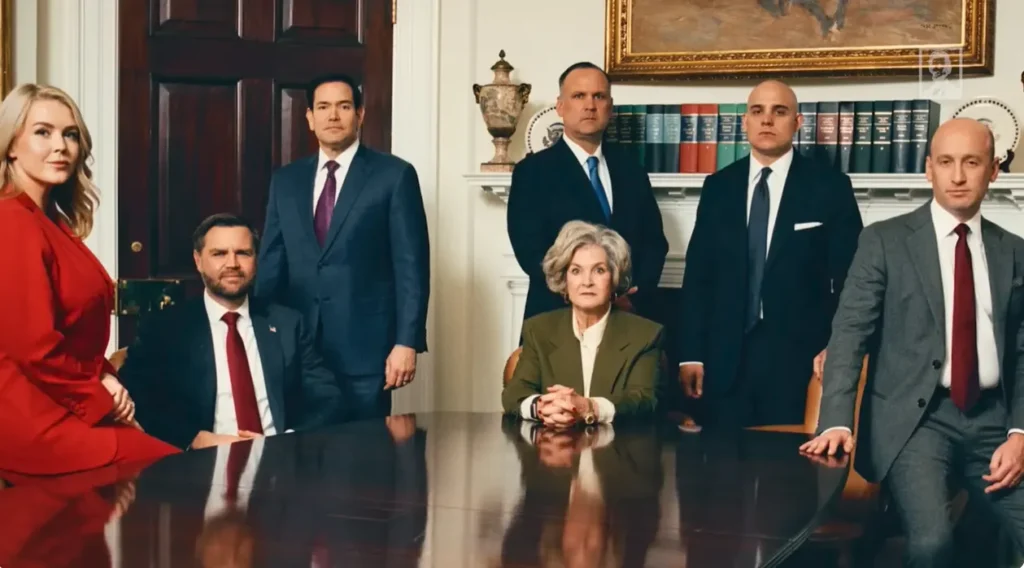
11:27 Chris: They were handpicked by Susie to be in that photo. That tells you something about whom she likes, sure. And it was kind of like an awkward class picture. I’m not sure anybody wanted to be there, but Susie said, “Be there.”
Chris supposes that those whom Susie chose to be in the Vanity Fair photo shoot are those she likes but I’d argue that these are the ones she needs to keep close. Trump isn’t one of them because the irony of his sociopathy is that, although he can effectively manipulate his cult followers, he himself can also be manipulated just as easily by someone of Susie Wiles’ prowess.
I’d further argue there’s a Grand Canyon of difference between appearances and actuality when it comes to Wiles’ relationship with the odious Stephen Miller.
12:39 Rick Wilson: I have picked up from some people previously that that Miller and she have some sort of detente, that she lets him run his little secret police empire largely without sanction or control.
13:02: But I did notice she also took a couple of pops at like the excesses of DHS and ICE in there [the Vanity Fair article]. I wonder how Miller’s going to react to that. Yeah. No, it’ll be interesting to see.
13:09 Chris Whipple: So far everybody’s rallied around Susie. I mean, I never heard her, for what it’s worth, over almost a year of talking to her. Um I never picked up on any antagonism between her and Miller. She spoke highly of him. She said he’s incredibly well read and he’s smart and obviously we all know he’s a loyal soldier. So, I didn’t pick up on any particular tension there.
I don’t believe for a second that Wiles likes Miller. She’s told Chris Whipple how “incredibly well read and smart” Miller is specifically to give Chris the impression that she thinks highly of the loathsome fascist because she needs Miller to believe it. She couldn’t risk Chris suspecting otherwise.
However, Chris does provide an interesting insider’s view of Trump’s relationship with her.
13:41 Chris: One observation that I heard from someone the other day, that I’d love to get your perspective on was that in some ways Trump is less engaged with the outcomes of things than he was before. He’s less carefully watching Fox every two minutes to see what they’re saying about him. He’s less obsessive about it. I guess that is something that Susie’s given him, a sort of a comfort level in that she’s going to take care of things.
It wouldn’t surprise me if Trump views Susie Wiles as a mother figure. If so, then it’s her approval that he most wants from her. That alone will keep her employed in his administration for as long as she wants the job.
Does Susie Wiles have ambition beyond White House Chief of Staff? It’s certainly evident that she’s carved out an extraordinary position of power for herself with impressive leverage. She’s made herself essential in the West Wing and wisely corralled all the loose cannons within her inner circle. She knows who’s who; the donors, the influencers, the billionaire wannabe plutocrats and she knows where they are on the game board. But you can bet they aren’t taking any notice of Susie Wiles. That’s an advantage for her, if she cares to use it.
She may also be the only one outside of Trump’s doctors who know his true condition and the medical estimate of his life span. Her position gives her extraordinary access to valuable information. If she has any designs on moving the game pieces on the political board, she’s uniquely positioned to do so without anyone being aware of what she’s up to before it’s too late to stop her.
But what might she do with this power? There’s any number of scenarios ranging from the barely possible to the improbable. At the extreme end, she could orchestrate the removal of Vance as VP and have him replaced by Marco Rubio. Though the Vanity Fair article paints her as equally supporting both men, she’s a master at projecting the impression she wants you to believe. And there are reasons to believe she favours Marco.
It isn’t that she has anything against Vance particularly, though she might; but I do believe she dislikes Peter Thiel. As the force behind Vance’s political promotion, Thiel would assume a preeminent position in the White House if Vance were to succeed to the presidency. That would likely lead to Susie losing her position which would mean the loss of all the power and influence she’s quietly amassed. Will she choose to use it rather than lose it?
Wiles and Rubio have known each other for years. She worked with him on his campaigns for Senate, and probably swayed Trump to nominate him for Secretary of State. So, what if Susie Wiles decided that Marco Rubio would be a better prospect as Trump’s successor? She’s certainly well positioned to assist him by initiating Vance’s downfall. Perhaps she’s working on it already. She’d gain popularity from both sides of the political aisle if she could pull it off.
This is speculation of course, but nevertheless, Susie Wiles is definitely a woman to watch.
Support the site with a subscription today and see no more ads!
 Go Ad-free Now!




















It’s like I wrote elsewhere after the VF piece came out–Wiles said absolutely nothing in those interviews that she hadn’t already told Drumpf she was going to say. Wiles ALWAYS had it planned that she would denounce the interviews as a “hit job” and that stuff was “missing” from the interviews (because she knew the reporter would print what she DID say but, since her boss has spent so much time vilifying legitimate news sources and reporters, the “base” would believe the interview was “rigged” against Wiles and, more importantly, Drumpf).