

I wouldn’t want to be Donald Trump, Jr. right now. He’s going to get (if it hasn’t happened already) a blistering blastfurnace of rage from his father for convincing him to choose J.D. Vance as the vice president. Although, if Trump could find it in his makeup to be honest for even one minute, he would admit that he needs mini me Vance to spew the MAGA toxin because he’s too exhausted to go out there and campaign himself. But have no fear of that, Trump doesn’t have a shadow of a scintilla of honesty anywhere in his entire being.
Here’s the latest with the downfall of the Republican ticket: Kevin Roberts (Head of the Heritage Foundation and architect of Project 2025) wrote a book, Dawn’s Early Light: Burning Down Washington To Save America, and featuring a lit match as artwork. Maybe that’s what Trump finally got wind up when he began to call Project 2025 “extreme” and claim he “didn’t know much about it.” The New Republic:
The subtitle and cover of Roberts’s book were softened as scrutiny of the Trump campaign’s ties to Project 2025 grew. The book, which is scheduled to be published on September 24, was originally announced with the subtitle “Burning Down Washington to Save America” and featured a match on the center of its cover. The subtitle is now “Taking Back Washington to Save America,” and the match is nowhere to be seen. Promotional language invoking conservatives on the “warpath” to “burn down … institutions” like the FBI, the Department of Justice, and universities has also been removed or toned down, though it is still present in some sales pages.
But the inspiration for that extreme language can be found in Vance’s foreword, which ends with a call for followers to “circle the wagons and load the muskets,” and describes Roberts’s ideas as an “essential weapon” in the “fights that lay [sic] ahead.” (The New Republic downloaded Dawn’s Early Light earlier this month from NetGalley, which provides advance copies of books to reviewers and booksellers. Copies were removed from the platform earlier this month.)
Vance does not explicitly mention Project 2025 in his foreword. He does, however, make clear that he is extremely close with Roberts and that he sees him as a strong ally in a shared political project. The foreword opens with the parallels in their biographies: Both are from poor families and had difficult childhoods, both are Catholic, and both are now working in Washington, D.C., to remake the country. Over the three-page foreword, Vance singles out Roberts in the areas where the two most strongly align politically. First, he praises Roberts for his willingness to criticize corporations and break with the GOP’s free-market orthodoxy; then, for his strong emphasis on the family. “Roberts is articulating a fundamentally Christian view of culture and economics,” Vance writes, by “recognizing that virtue and material progress go hand in hand.” […]
On Tuesday, the Trump campaign’s public attacks on Project 2025 bore fruit: The project is shuttering its policy operations, and its director, Paul Dans, is stepping down. “Reports of Project 2025’s demise would be greatly welcomed and should serve as notice to anyone or any group trying to misrepresent their influence with President Trump and his campaign—it will not end well for you,” the Trump campaign said in a statement. But it’s not clear that Project 2025 itself is ending, as Roberts reportedly is taking over its operations. (The Heritage Foundation, the Trump campaign, and HarperCollins did not respond to multiple requests for comment before publication.)
“Reports of Project 2025’s demise would be greatly welcomed and should serve as notice to anyone or any group trying to misrepresent their influence with President Trump and his campaign—it will not end well for you,” is complete bullshit. All that happened is that Paul Dans became a sacrificial lamb. It’s a transparent and obvious ploy to say that Project 2025 is something “bad” and Trump has nothing to do with it and has distanced itself. There is no “demise” of Project 2025. Nothing has changed. A few chairs may have been rearranged, for purposes of show, but Project 2025 is still out there and destined to be the blueprint for a second Trump administration. Here is Vance’s leaked foreward, in full:
In the classic American film Pulp Fiction, John Travolta’s character, recently returned from Amsterdam, observes that Europe has the same consumer goods as America, but there it’s just a “little different.” That’s how I feel about Kevin Roberts’s life. He grew up in a poor family in a corner of the country largely ignored by America’s elites—but his corner was in Louisiana and mine in Ohio and Kentucky. Like me, he’s a Catholic, but unlike me, he was born into it. His grandparents played an outsized role in his life, just as mine did. And now he works far from where he grew up, just a few steps from my office, in Washington, DC: he is the president of one of Washington’s most influential think tanks, and I’m a US senator.
Now he has written the book you hold in your hands, which explores many of the themes I’ve focused on in my own work. Yet he does so profoundly, with a readable style that makes accessible its real intellectual rigor.
Never before has a figure with Roberts’s depth and stature within the American Right tried to articulate a genuinely new future for conservatism. The Heritage Foundation isn’t some random outpost on Capitol Hill; it is and has been the most influential engine of ideas for Republicans from Ronald Reagan to Donald Trump. Yet it is Heritage’s power and influence that makes it easy to avoid risks. Roberts could collect a nice salary, write decent books, and tell donors what they want to hear. But Roberts believes doing the same old thing could lead to the ruin of our nation.
If you’ve read a lot of conservative books or think you have a good sense of the conservative movement, I suspect the pages that follow will be surprising—even jarring. Roberts understands economics and supports basic free market principles, but he doesn’t make an idol out of decades old theories. He argues persuasively that the modern financial corporation was almost entirely foreign to the founders of our nation. The closest eighteenth-century analogue to the modern Apple or Google is the British East India company, a monstrous hybrid of public and private power that would have made its subjects completely unable to access an American sense of liberty. The idea that our founders meant to make their citizens subjects to this kind of hybrid power is ahistorical and preposterous, yet too many modern “conservatives” make such an idol out of the market that they ignore this. A private company that can censor speech, influence elections, and work seamlessly with intelligence services and other federal bureaucrats deserves the scrutiny of the Right, not its support. Roberts not only gets this at an instinctive level; he can articulate a political vision to engage in that scrutiny effectively.
Roberts sees a conservatism that is focused on the family. In this, he borrows from the old American Right that recognized—correctly, in my view—that cultural norms and attitudes matter. We should encourage our kids to get married and have kids. We should teach them that marriage isn’t just a contract, but a sacred—and to the extent possible, lifelong—union. We should discourage them from behaviors that threaten the stability of their families. But we should also do something else: create the material circumstances such that having a family isn’t only for the privileged. That means better jobs at all levels of the income ladder. That means protecting American industries—even if it leads to higher consumer prices in the short term. That means listening to our young people who are telling us they can’t afford to buy a home or start a family, not just criticizing them for a lack of virtue. Roberts is articulating a fundamentally Christian view of culture and economics: recognizing that virtue and material progress go hand in hand.
My childhood was not, by any objective measure, easy. Neither was that of Kevin Roberts. Both of us were negatively impacted by family instability, and both of us were saved by the resilience of the thick network of family—grandparents, aunts, uncles—that is often the first and most effective component of our social safety net. Both of us saw how a factory leaving a town could destroy the economic stability that provided the foundation for those families. And both of us learned to love the country that gave both of us and our families second chances, despite some bumps along the way. In these pages, Kevin is trying to figure out how we preserve as much of what worked in his own life, while correcting what didn’t. To do that, we need more than a politics that simply removes the bad policies of the past. We need to rebuild. We need an offensive conservatism, not merely one that tries to prevent the left from doing things we don’t like. [Emphasis mine]
Here’s an analogy I sometimes use to articulate what the previous generation of conservatives got right and wrong. Imagine a well-maintained garden in a patch of sunlight. It has some imperfections of course, and many weeds. The very thing that makes it attractive for the things we try to cultivate makes it attractive for the things we don’t. In an effort to eliminate the bad, a well-meaning gardener treats the garden with a chemical solution. This kills many of the weeds, but it also kills many of the good things. Undeterred, the gardener keeps adding the solution. Eventually, the soil is inhospitable.
In this analogy, modern liberalism is the gardener, the garden is our country, and the voices discouraging the gardener were conservatives. We were right, of course: in an effort to correct problems—some real, some imagined—we made a lot of mistakes as a country in the 1960s and 1970s.
But to bring the garden back to health, it is not enough to undo the mistakes of the past. The garden needs not just to stop adding a terrible solution, though it does need that. It needs to be recultivated. The old conservative movement argued if you just got government out of the way, natural forces would resolve problems—we are no longer in this situation and must take a different approach. As Kevin Roberts writes, “It’s fine to take a laissez-faire approach when you are in the safety of the sunshine. But when the twilight descends and you hear the wolves, you’ve got to circle the wagons and load the muskets.”
We are now all realizing that it’s time to circle the wagons and load the muskets. In the fights that lay ahead, these ideas are an essential weapon.
—J.D. Vance
This isn’t all that threatening, insofar as forewards to books go, but you get a few key principles here:
- Vance is obsessed with marriage, meaning heterosexual marriage.
- His comment about “offensive conservatism” tells you what you need to know. This is the rational for gutting the Civil Service and installing Trump loyalists in its place.
- The “circle the wagons and load the muskets” is rationalizing a violent takeover of the federal government, in the name of some vague greater good and return to some imaginary halycon time, but only an idiot wouldn’t understand that this is a manifesto written to justify oligarchy in place of democracy.
- And Vance has made these comments before, about the “class” that makes decisions and runs the show. He is bought and paid for by Peter Thiel and he wants Thiel and the other billionaires to buy America as a co op.
The publication of Roberts’ book has met with delay. It was scheduled to be published September 24, probably deliberately that close to Election Day. The original concept was to show how strongman Trump, he who took a bullet for democracy and was chosen by God, was now going to come in and take charge and rule with an iron fist. Since Joe Biden stepped down and since Kamala Harris and now Tim Walz are taking Election 2024 in a totally unanticipated and unforeseen direction, Project 2025 is being exposed as the monstrous plot that it is.
And J.D. Vance writing the foreward is prima facie evidence of where he stands with respect to Project 2025. And Donald Trump’s claim that he doesn’t know anything about Project 2025 and has nothing to do with it, when his vice president is telling everybody to read all about it, falls flat on its ass.
But this is how stupid Trump and Vance believe Americans are.











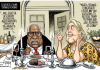











“…it won’t end well for you.”
Lemme see, that is truly a heart-warming and welcoming salutation, ain’t it.
Nice family ya got there, kiddo, nice if ya could keep ’em, huh?
Phuck all you RWNJs. The BLUE WAVE is coming. Go back under your rocks.
I often read stuff on the computer and/or write with my TV on. Frequently tuned to news. I’m pretty sure I heard Nicole Wallace say that book’s publication is now postponed until AFTER the election. Gee, I wonder why? The problem of course is that advance copies have gone out and some have made their way into what for Team Trump are unfriendly hands. Not to mention Project 2025 published their entire 900 (plus) page manifesto many months ago. An arrogant move to be sure but also a pretty fooking stupid one.
As for it shutting down. Well, the plan is written and people have already been selected to begin implementing it during the transition and THEY have done plenty of advance work. So in reality there really isn’t a need for the Heritage Foundation to maintain some offices labeled Project 2025. Not that there still isn’t a need to keep that train running, it will just be done quietly in some other place but the bosses at Heritage WILL be in the loop!
The word you want is spelled “Foreword,” not “Foreward”.
For two Catholics,,these two seem fundamentally unaware that the Catholic Church (I had 17 years of Catholic education,including a minor in theology) doesn’t equate virtue with material progress. Nor do the Gospels support this view. In fact, Jesus,taught that it is,easier for a camel.to fit through the eye of a needle than for a rich man to get into heaven.
What Vance is spouting is the extreme right-wing of Christian teachings: the doctrine of election. This bit says that those the Lord favors are blessed with wealth and success,,so obviously the poor are screwed. There is no basis in the Gospels for this. In point of fact, the Beatitudes teach the exact opposite and bless those,who help the poor. Guess they are in a different version of Catholicism than the one I was raised and educated in.