
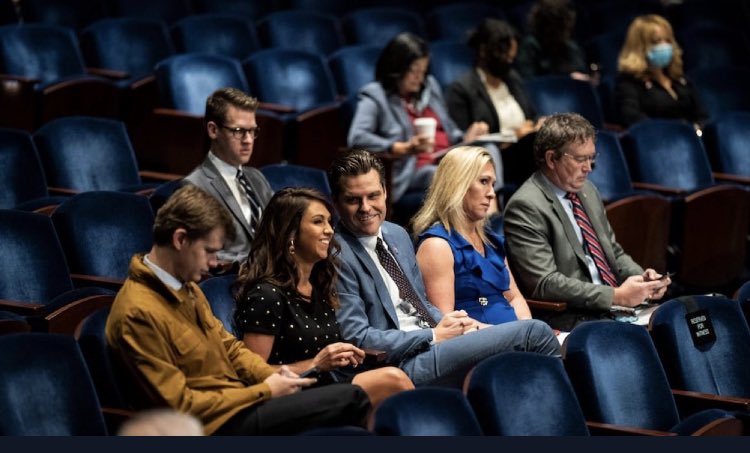
I-Ron the goddess of Irony just resurrected the other day but if this keeps up her head will explode. Dan Crenshaw did two amazing things, make that three, which you will see in the clip below. 1. He calls out the Freedom Caucus; 2. He praises Adam Kinzinger; and 3. He puts down congress critters who are performative artists and considering his track record that is quite a whopper of a statement.
Wowie! Dan Crenshaw trashes ‘Freedom Caucus’ members Greene, Brooks, Gohmert, Gosar, Jordan, etc, as “performance artists” while defending Kinzinger. “We have grifters in our midst .. lie after lie after lie.” ? pic.twitter.com/hoaGOcOx9s
— Ron Filipkowski (@RonFilipkowski) December 7, 2021
Now the Dan Crenshaw that I know is a co-signer of the worst fraud in the history of this nation, namely the Big Lie.
But yet he's pushing the big lie ? pic.twitter.com/B6jYW3Gj2S
— Brokenbox (@Resister1789) December 7, 2021
That’s where Crenshaw gets disingenuous. Now here’s where he gets positively comical disparaging congress members who are “performative artists.” If this isn’t pure Hollywood, it will do until the real thing comes along.
Any performative artistry there? If you weren’t convinced of Crenshaw’s performative artistry by his Dollar Tree Mission Impossible performance, how about this?
And it comes as no surprise that many months ago Crenshaw walked back his participation in Ken Paxton’s specious lawsuit. CNN, May 17, 2021:
Crenshaw and 125 other House Republicans backed the Texas lawsuit in a submission to the court known as an amicus brief. Crenshaw defended his decision in a Sunday appearance on NBC’s “Meet the Press” — telling host Chuck Todd that the amicus brief has been unfairly portrayed by the media.–“You guys in the press painted that as some extreme action, and of course it wasn’t,” Crenshaw said. “That amicus brief was a simple question of the Supreme Court, in saying, ‘Can you please speak to this question of whether, of whether process changes in the election — last minute, not approved by the legislature — can be deemed constitutional?’ It was a question, and they didn’t want to answer that question.”
Facts First: Crenshaw’s claim is misleading. The House Republican amicus brief did not merely ask the court to answer a constitutional question. In reality, the brief expressed a firm opinion — that the four Biden-won states had taken “unconstitutional actions” — and asked the Supreme Court for a specific response: to allow Texas’ lawsuit to proceed and to grant Texas’ request for a preliminary injunction forbidding the four states from certifying Biden’s victories until the lawsuit was resolved. The brief also invoked baseless claims of election fraud, saying that “the election of 2020 has been riddled with an unprecedented number of serious allegations of fraud and irregularities.”When CNN invited Crenshaw spokesman Justin Discigil to comment for this fact check, Discigil made a claim that was even more untrue than Crenshaw’s original claim. […]
What the experts say about Crenshaw’s claim
There is a kernel of truth to Crenshaw’s comments on “Meet the Press.” The House Republican amicus brief did say the Supreme Court should “determine for the people if indeed the Constitution has been followed and the rule of law maintained.”But Crenshaw made it sound as if the brief solely consisted of this kind of neutral request. It didn’t, as a plain read of the text makes obvious and as three election law experts told CNN on Monday.–“In fairness, the language of the amicus brief was restrained in a way that the language of Texas’s briefs was not. So I would not be surprised if some people believed that this amicus brief was simply asking the Supreme Court to review the case, nothing more. However, the text of the amicus brief clearly goes beyond that simple request,” Lisa Marshall Manheim, a law professor at the University of Washington, said in an email.–Manheim noted that the amicus brief “repeatedly stated that the conduct of defendant states was unconstitutional” and that the brief asked the court to grant the preliminary injunction.–David Schultz, a professor of political science and legal studies at Hamline University, said Crenshaw incorrectly made it sound like the brief was asking the Supreme Court for a non-binding “advisory opinion.” Since “the Supreme Court long ago said federal courts do not give advisory opinions,” Schultz said, a first-year law school student is taught that “you would never file something where you say, ‘We’re just kind of curious, what do you think?'”This brief, Schultz noted, proposed that the Supreme Court take specific actions.–Rick Hasen, a law professor at the University of California, honed in on another component of the brief — the fact that it said its 126 signers believe “the unconstitutional irregularities involved in the 2020 presidential election cast doubt upon its outcome and the integrity of the American system of elections.”–“That’s taking a side in favor of the spurious allegations in Texas’s suit,” Hasen said in an email.
The spokesman’s response
When we asked Crenshaw’s office for comment, Discigil said in an email: “The conclusion of the amicus brief specifically states that the Supreme Court should objectively review the argument presented in the Texas lawsuit and make a determination. It doesn’t make any specific request of the court or urge any specific outcome, and certainly didn’t ask the court to overturn election results in states. It asked the court to weigh in on the lawsuit, which ultimately did not happen.”–That’s just flat wrong. The conclusion of the amicus brief did make a specific request of the court beyond just objectively reviewing the Texas argument. In fact, it made two specific requests. Here’s how the conclusion ends:
“It is now the duty of this Honorable Court to objectively review the facts presented by the Plaintiff in this historic case, render judgment upon the unconstitutional actions in the Defendant states, and restore the confidence of all Americans that the rule of law will be upheld today and our elections in the future will be secured. For the reasons stated above, the Plaintiff’s Motion for Leave to File a Bill of Complaint and Motion for a Preliminary Injunction should be granted.”–So: there’s 1) an explicit request for the court not to dismiss the Texas lawsuit and 2) an explicit request for the court to impose a preliminary injunction. And right before that, there is an explicit argument that the four states had acted unconstitutionally.Discigil also said in his email: “This amicus brief was filed in early December, when there were still questions regarding the constitutionality of changes certain states made to election procedures without the approval of their legislatures. Congressman Crenshaw signed the amicus brief to ask the Supreme Court to answer this question: were these moves constitutional? The amicus brief would not have overturned the election results and would not have disenfranchised anyone. Congressman Crenshaw would not have supported any effort to do either of those things.”–This is absurd. Of course the amicus brief would not itself have overturned the election: an amicus brief is not an actual lawsuit that gets ruled on by a court, just a legal submission that discusses a lawsuit. But there is no evading the fact that the amicus brief Crenshaw endorsed was filed in support of a lawsuit that sought to overturn the election — nor the fact that the amicus brief asked the court to halt the certification of Biden’s victory.













I wonder what he thinks is about to happen to them.
My only question over the whole thing with the Texas suit is how EXACTLY did Texas have any standing in questioning how another state handles its own election laws?
It didn’t, as the court said, in rejecting the suit at the beginning.
Crenshaw has figured out (finally) which way the wind is blowing. Had she not already been persona non grata, it’d be Cheney he’d be praising but Kinzinger is an acceptable substitute. Pay attention to this…mark how often it happens heading into 2022. The Trump Train is rapidly running out track.
They may be performance artists, but the thing is that they are in positions of influence and no one seems to have the will to pry them loose and shut them up.