
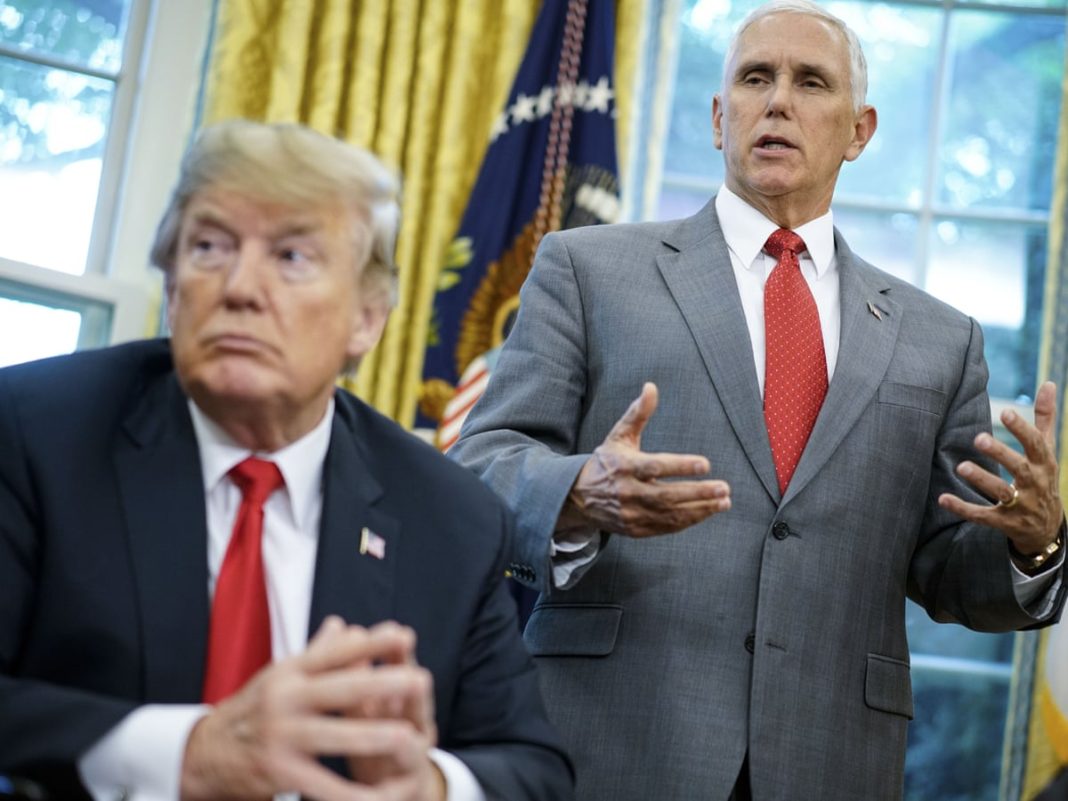
Both Donald Trump and Mike Pence are cast in roles in a morality play right now. Conservative Christians are attending the Road to Majority Conference in Orlando this weekend and the word on the street is what you would expect, that Trump is the martyr who will rise again, and Pence, perhaps to his surprise but no one else’s, is cast as Judas.
And the choice of Florida as the venue was no coincidence: its governor, Ron DeSantis, is seen as Trump’s heir apparent. Jonathan Riches, 42, from Tampa, wearing a red “Maga” hat and “I ♥ Ron DeSantis” t-shirt, said: “I’ve fallen in love with DeSantis as much as I love Trump. I’d be OK with Trump handing on the torch to DeSantis.”
Riches – a rightwing activist with a reputation for litigiousness and spreading falsehoods – booed Mike Pence during his speech on Friday because of the former vice president’s refusal to overturn the election result; others in the room shouted “Traitor!” and were escorted out.
“We feel like he abandoned Trump,” Riches explained. “We needed him to challenge the election. He doesn’t represent our party. He’s now trying to redeem himself but we don’t want him.” […]
Trump, who turned 75 this week and resumes campaign rallies next Saturday in Ohio, has hinted that he might run for president again in 2024. Many who attended the Road to Majority conference pledged to support him if he does, although few wanted Pence to be his running mate again.
Lindsey Graham is also at the conference and you’ll love this statistic. Somehow he’s lost the seven million votes that Joe Biden won by and he’s substituted the number 44,000.
Members of Congress who addressed the conference on Friday duly gave the 2020 election a wide berth. One exception was Lindsey Graham, a senator from South Carolina, who said Trump lost by only 44,000 votes in the electoral college: “44,000 votes short and we can argue about being cheated and there was a lot of shenanigans, right?”
The speakers, including several potential 2024 candidates, highlighted the urgency of winning back the House of Representatives next year but avoided saying that Trump should run two years later. Graham chose his words carefully when he said: “If we can pull this off, take back the House and Senate, then 2024 becomes ours to lose. Imagine four more years of Donald Trump policies.”
I don’t know how Lindsey Graham lives with himself. Maybe he’s a got a portrait stashed somewhere that looks even worse.
If you’re gagging on Graham still, you might want to wait a few minutes before digesting Ted Cruz’ contribution to the convention. He wants to further obliterate the separation of church and state.
Senator Ted Cruz of Texas urged church pastors to become more politically engaged. He said: “If we are going to defeat the woke assault then all of us need to wake up. The slumbering church needs to wake up.”
Cruz suggested that politics is subject to a natural pendulum swing that is bound to come back in Republicans’ direction. “It took Jimmy Carter to give us Ronald Reagan. Joe Biden is Jimmy Carter 2.0 and I’m here to tell you: revival is coming.”
Cruz is right that there is a pendulum swing to politics. That has led to the rise or fall of many a candidate. John McCain was on the wrong side of the pendulum, even though as a candidate he was many lightyears beyond Donald Trump, who was on the right side of the pendulum. There’s no questioning but that the party out of power will return to power at some point, it’s only a question of when.
Right now it appears that Ron DeSantis is Trump 2.0. Whether that’s a viable stance or not will be determined in 2022, which is shaping up to be a pivotal year. If Trump’s angry revenge tactics hold up the way he expects and he’s able to wipe out candidates, such as Lisa Murkowski, by endorsing their opponents, then he might be set up for a 2024 run. If, as some people predict, Trump has run out of gas and he’s not coming back — not the least of which reason is his legal encumbrances, which are becoming more problematic as the days tick by — then DeSantis might be the GOP’s great white hope.
But then again, this commentary is coming from DeSantis’ state, so factor that in. It’s a long long way to 2024 and what happens in the 2022 midterms is going to be decisive. The GOP is still in free fall and the laws of political physics are uncertain right now. Take conventional wisdom and the usual midterms playbook with a grain of salt.



















The separation of church and state is to prevent one church from becoming dominant or state sponsored, to protect the various beliefs or non-beliefs of citizens, and to allow churches, synagogues, and mosques and other houses of worship to practice their faiths. Is it only Dems who remember this? Some churches used to value this separation for this very reason, it protected their “free exercise” of religion.
Grr.
If it didn’t mean hell on earth for the rest of us (largely figurative, but not ruling out a literal interpretation), I’d say let these religious nuts HAVE no more separation of church and state and let them fight out WHICH SPECIFIC denomination would hold sway. I’ve got a feeling that even the most ardent supporters of letting “the church” become part of “the state” would quickly be demanding that the government put up a “wall” because they happen to be part of the “wrong” church.
They fail to remember that, in colonial times and persisting until well into the 19th century, an “established” church was the norm. Not “established” in the sense of being founded but as part of the “establishment.” EVERYONE was required to pay in order to prop up one specific Christian denomination over all others as well as any other faith (notably Judaism). If you were a Baptist in Danbury, Connecticut, you were expected to help fund that state’s established church (the Congregational Church) through your tax dollars. You could opt out of the system through various means but that would lead to your own being stripped of certain rights (eg, you might not be allowed to participate in town hall meetings or even be allowed to run for office). That, for the record, is directly responsible for our current “wall of separation” because the Danbury Baptists sent a letter to President Thomas Jefferson seeking some relief from being forced to pay for another denomination’s upkeep.
The US has always given preferential treatment to CHRISTIANS in general, rather than promoting one denomination over another; it’s just the pesky Christian denominations that spoil things by denigrating other denominations (the longtime Protestant denominations’ bias against Catholics, Roman Catholic bias against Eastern Orthodox adherents, the evangelical bias against Mormons–though that group faced discrimination from most other Christian groups, it was still mostly evangelicals who had the “hold my nose to vote for Romney” in 2012). But, even among other faiths, there tends to be bias. You’ve got Orthodox Jews in the US who maintain a certain hostility towards Conservative Jews and definitely towards Reformed Jews while Muslims are easily split between the larger Sunni community and smaller Shia community (to say nothing of the other groups). And, of course, let’s not forget the minority faiths (Native American Church, Santeria, the Church of Satan, etc) and agnostics and atheists.
I don’t think DeSantis is going to get as far as he wants to think. We’ve all heard far too much about Florida.
Cruz’s comment about Carter is deliciously ironic as Carter (who spent many a Sunday, even during his Presidency, at his hometown church in Plains, GA, involved directly with the weekly services) was a devout Southern Baptist and much of the criticism he faced in 1976 was that he was viewed as “too religious” whereas Reagan only got religious support because the evangelicals who expected Carter to *use* his religious background as a political cudgel were disappointed that Carter did just the opposite (and sort of followed that silly nonsense that Jesus preached about “rendering to Caesar”). Of course, Reagan talked the right talk but he knew that the evangelicals’ social demands were absurd and would never be accepted by the majority of Americans. And as long as he kept making the promises and saying the right words, they accepted his “promises.” When Bush ran in 1988, he didn’t expect to be challenged since he’d be VP but wound up with several, including Pat Robertson (who ended up with 9% of the total GOP primary vote and over 200 delegates, and got a key speaking role at the Convention). And then he faced another challenge in 1992 with far-right nut Pat Buchanan (who ended up with 23% of the GOP primary vote). Both years, the “Christian Coalition/Moral Majority” posed a big threat to Bush because he wasn’t “pure” enough for them (his son didn’t have that issue to deal with since he made such a big deal about he’d turned from booze and drugs because of “faith” and he played up some of his more religious-oriented aspects to help him pull the evangelicals into his corner).
But Trump never played up any faith issues until after he was assured of the nomination (there were other candidates who had far more compelling faith-related credentials but none could really unite the evangelicals). No, he preferred to rely on his personality plus his “outsider” status (along with the underlying racism that had been fostered among the GOP during the Obama years) to get him through. Then, he realized that all of that wouldn’t be enough to get that heavy evangelical vote which helped ensure Pence (who’d become a veritable poster boy for the evangelical movement–and its extremist social conservatism–with his signing laws in Indiana that made life difficult, to say the least, for the LGBTQ community). And it’s not like there wasn’t evidence that winning the evangelical vote wasn’t behind Pence’s selection. It was widely discussed in the media, especially as Indiana wasn’t exactly liable to go blue (even if Bernie had been the nominee, the state was going red; Obama only managed to eke out a 1.03% win in 2008 but still ended up under 50% and then lost in 2012 by more than 10 percentage points; in 2016, Donald Trump got almost as many GOP primary votes by himself as were cast in the Democratic primary campaign that year–just under 639,000 votes were cast in the Democratic race while Trump got more than 590,000 in the GOP race out of 1.1 million–and Ted Cruz’s 406,000 primary votes still surpassed both Clinton and Sanders’ separate votes.)