
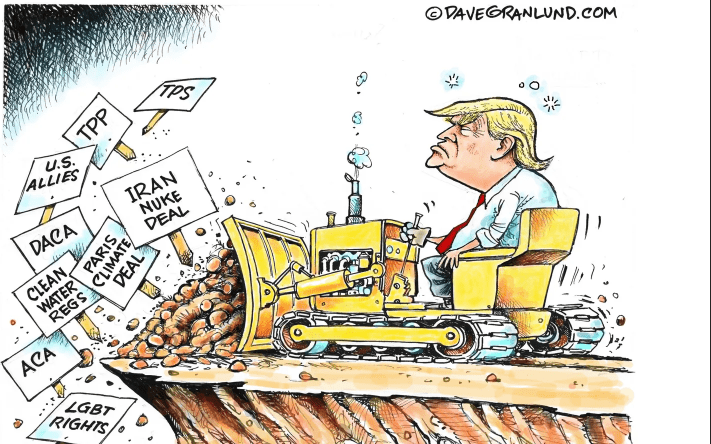
This fits perfectly and explains a lot of Trump’s “thinking” on who he will appoint and how he will shove his appointees down peoples’ throats, Senate confirmation or no. Do you remember a comment Trump made in January, 2019: “I like acting [appointments]. It gives me more flexibility. Do you understand that? I like acting.” Acting is the word here. That’s what MAGA officials are, a bunch of Botoxed bimbos acting like they’re legitimate lawyers, legislators, you name it.
The lay of the land is simple. Trump has nominated Kash Patel, Pete Hegseth and others who are going to have a hell of a time getting approved, even by a GOP-ruled Senate. So the key is to put people in as “acting” this or that. That’s as close as Trump can come to getting his cake and eating it, too. He may not ultimately get the person approved but he has the person doing his bidding for a long time, at least 210 days.
On Kash Patel and the Underappreciated Federal Vacancies Reform Act:
A NYT article today about Trump nominees and Senate independence worries that Trump could “erode the Senate’s authority to pass judgment on nominees by,” among other things, “sidestepping it through recess…
— Jack Goldsmith (@jacklgoldsmith) December 1, 2024
Here’s the entire tweet:
“On Kash Patel and the Underappreciated Federal Vacancies Reform Act: A NYT article today about Trump nominees and Senate independence worries that Trump could “erode the Senate’s authority to pass judgment on nominees by,” among other things, “sidestepping it through recess appointments.” Like so many analyses of Trump’s appointments strategy, this article ignores a different and entirely lawful route for Trump to appoint loyalists to senior executive branch positions without Senate confirmation: the Federal Vacancies Reform Act (FVRA).
–
FVRA establishes rules for presidents to appoint “temporary” (but long-term) acting officials to positions for which Senate advice and consent is otherwise needed. It applies whenever a vacancy occurs because a Senate-confirmed official “dies, resigns, or is otherwise unable to perform the functions and duties of the office.” 5 USC 3345. Trump’s announcement yesterday that he will nominate Kash Patel to be Director of the FBI is a great example of how FVRA might work.
–
Patel won’t be confirmed for months after Trump becomes president on January 20, if ever. But current FBI Director Chris Wray will either resign before January 20 or be fired on that date. A crucial issue for the incoming Trump administration, therefore, is to determine who will be acting FBI Director on January 20. Under FVRA, Trump could appoint someone as acting FBI Director for potentially more than two years without Senate confirmation. The importance of FVRA goes far beyond Patel, since it gives the president broad authority to skirt the Senate and appoint loyalists to Senate-confirmed positions throughout the executive branch on an “acting” basis.
—
The FBI succession regulation will determine in the first instance who runs the FBI if Wray resigns before January 20, or is fired on that date. See Federal Register, February 14, 2007, at page 7343. During the period after Wray leaves (by whatever means) and Patel or someone else is confirmed as FBI Director, Deputy FBI Director Paul Abbate—assuming he doesn’t resign and isn’t fired—would be first in succession to be acting Director under the regulation, until Trump as President chooses otherwise. (Since Wray named Abbate as Deputy Director in 2021, I assume Abbate is unlikely to be viewed with favor by the incoming Trump administration.) After Abbate comes Associate Deputy Director Brian Turner, then Executive Assistant Director of the National Security Branch, Larissa Knapp, followed by several other senior career officials.
—
The regulation sets the succession default—a default that accords with Trump’s first option to name an acting Director under FVRA, since that option is to replace Wray with “the first assistant to the office.” 5 USC 3345 (a)(1). But FVRA gives Trump two additional options to replace Abbate or a different regulation-specified successor as acting Director of FBI. First, Trump could choose any Senate-confirmed officer from anywhere in the administration to serve as acting director. 5 USC 3345 (a)(2). That means that Trump could name anyone the Senate confirms for any position in the Trump administration to serve as Acting FBI Director. This implication of FVRA raises the stakes nontrivially for every Trump nominee before the Senate! Trump could also appoint a loyalist currently in a Senate-confirmed position on a multi-member board with partisan requirements.
—
He could, for example, name Brendan Carr—who Trump nominated to be FCC Chair, but who is currently a Senate-confirmed FCC Commissioner—as acting FBI Director. Holdover Senate-confirmed FEC Commissioner Trey Trainor, who worked on Trump’s 2016 presidential campaign, is another possibility. There are others. Second, Trump can choose any FBI official whose rate of pay is “equal to or greater than the minimum rate of pay payable for a position at GS–15 of the General Schedule” and who has been in the FBI for 90 days during the previous year. 5 USC 3345 (a)(3). There are several hundred people in the FBI whose rate of pay is equal to or greater than a GS-15 position. I expect that the Trump team is currently scouring this group for a loyalist. (There are other restrictions under 5 USC 3345 that I think are not plausibly relevant here.)
—
Someone appointed by Trump via either of the two mechanisms above could run the FBI for a long time. An acting official appointed at the beginning of an administration can serve for 300 days. 5 USC 3349a. But the clock would stop running when Trump formally nominates Patel and during his pending nomination. If the Senate rejects Patel, or Patel withdraws, the clock is reset for 210 days. 5 USC 3346. If Trump nominates a second candidate who is rejected or withdraws, the clock starts yet again. Anne Joseph O’Connell in the definitive work on FVRA says this scheme in theory permits an acting official to serve for more than two and a half years. See O’Connell, Actings, 120 Colum. L. Rev. 613, 631 (2020).
—
Viewed through the FVRA lens, the Patel nomination is a win-win for Trump. The Patel nomination will be a lengthy affair at a minimum. If the Senate rejects him or he withdraws, the length of the process, followed by what may be another controversial nominee, gives the President the backup option of a loyalist atop the FBI for a long time without Senate confirmation. Trump has the option, that is, if he can find a loyalist who is at GS-15 pay or greater within the FBI or who is in some Senate-confirmed slot in the administration.
—
I am confident the Trump Team has thought through the FVRA mechanism described above. The Trump administration used (or tried to circumvent) FVRA in imaginative ways during its first term. The Trump team has been planning since 2021 to exploit every legal avenue for a re-elected Trump to impose his will maximally throughout the executive branch. Moreover, the first Trump administration was not by a mile the first to fill many senior executive branch positions with acting officials for a lengthy period. The loophole-filled FVRA was a (failed) congressional response in 1998 to President Clinton’s perceived manipulation of the prior Vacancies Act.
—
And the George W. Bush and Obama administrations used acting officials under FVRA aggressively. The FVRA path, in short, is well trod in the executive branch. And the use of FVRA as described above to appoint acting officials is perfectly lawful since Congress expressly authorized it. FVRA applies to basically all vacancies in Senate-confirmed offices throughout the executive branch, including cabinet level officials. Remember acting Attorney General Matthew Whitaker? Trump chose him to run the Department after Trump fired Jeff Sessions and until William Barr was confirmed. Because Whitaker had been Sessions’ chief of staff at a pay rate equal to or greater than GS-15 for over a year, Trump could appoint him as acting Attorney General under 5 USC 3345 (a)(3). OLC approved the move even though DOJ has a Department-specific succession statute for the Attorney General. See 28 USC 508. Section 508, OLC concluded, did not “displace the President’s authority to use [FVRA] as an alternative.” OLC Memorandum on Designating an Acting Attorney General, 11-14-18.
—
Bob Bauer and I in our book “After Trump” described the FVRA scenarios above and many other FVRA loopholes, and proposed reforms to narrow presidential discretion to circumvent the Senate (in exchange for Congress significantly reducing the member of Senate-filled positions). This proposal, like so many others to reconstruct the presidency, got nowhere in the last four years. I should for completion’s sake note two caveats to the above analysis. First, if Wray stays on and forces Trump to fire him, Trump’s authority under FVRA to replace him could narrow.
—
The reason is that it is unsettled whether a vacancy created by presidential firing triggers the FVRA authority due to the officeholder being “unable to perform the functions and duties of the office” under 5 U.S.C. § 3345. On that issue, and some of the possible implications, see this terrific student Note: Ben Miller-Gootnick, Boundaries of the Federal Vacancies Reform Act, 56 Harv. J. on Legis. 459 (2019). Second, the president has options to achieve the functional equivalent of acting officials by circumventing FVRA through delegation of the tasks of the vacant office. O’Connell discusses how this works at pp. 633-35 of her piece. Bauer and I describe it at pp. 318-19, and 324-25 in “After Trump.” This gambit too has been used by many presidential administrations. I close by noting my surprise at the exorbitant attention given to recess appointments and the relative dearth of attention given to the president’s options under FVRA.
—
The excessive focus on recess appointments resulted from Trump’s November 10 tweet: “Any Republican Senator seeking the coveted LEADERSHIP position in the United States Senate must agree to Recess Appointments (in the Senate!), without which we will not be able to get people confirmed in a timely manner.” But as Bauer and I wrote in 2020 in “After Trump”: FVRA “gives the president pretty broad discretion, with fairly long time periods, to appoint acting officials for vacant Senate-confirmable slots. And presidents have used this authority as they saw fit. The need to do so grew after the Supreme Court’s decision in NLRB v. Noel Canning and the Senate practice of conducting pro forma sessions practically killed the possibility of recess appointments.” FVRA is the way that Trump will put in place loyalists through the administration on January 20. Recess appointments are largely a distraction. PS: I wrote this quickly and FVRA is very technical. Please let me know if I made a mistake and I will amend.”
That’s it. That’s what will happen when the rubber meets the road. I believe that the recess appointments idea was a distraction. That sounds Trumpian to me. And I believe what Goldsmith said here, that Trump’s lawyers and allies have been poring over this for the four years he was out of office and making their plans — just like they put together Project 2025.
There is some comfort in knowing what is coming. At least now we can figure out how to counter it. And that is going to be the basic dynamic going forward for at least the next two years, figuring out the best way to stonewall the extremism to come.






















Musk are you watching?
We hate you.
Leave immediately.
Your handlers cannot protect you.
We hate your boss too.
Politizoom just fold and kiss the ring(sweaty balls of Trumplet).
Get tough on the Shitler King.
Grow some
We ARE pushing back – both feature writers and commentors. Sure, there are some harsh realities of what we’re facing we talk about but we are still here pointing out what’s going on, both the big stuff in the headlines and other things that aren’t the two or three stories the networks harp on all day long. I won’t lie and say I wasn’t in a funk but I’m getting back to my old self. So are others.
why bother having confirmations in the first place?
Right on ecelia!