
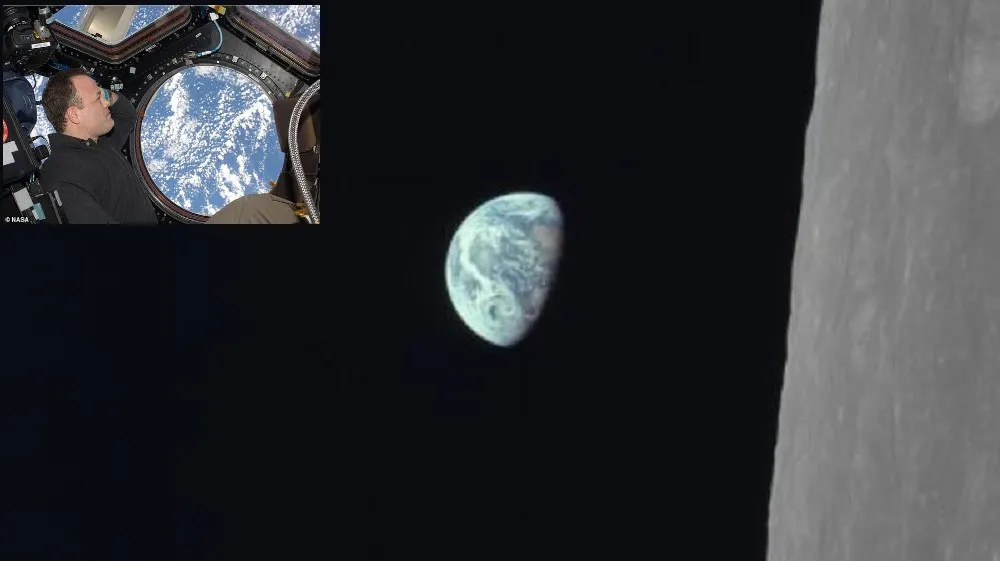
We set out to explore the moon and instead discovered the Earth (Bill Anders, Apollo 8)
I was only eleven years old on Christmas Eve in 1968. I recall watching the live broadcast from lunar orbit that evening, torn between sitting as close as mom would allow to the TV and wanting to run outside where my telescope was aimed at the moon. (No it wasn’t powerful enough to see the Apollo 8 spacecraft but kids dream) Profound as that was, something had taken place that morning we wouldn’t learn until later. Bill Anders was witness to the very first “Earth Rise” in human consciousness and somehow had the presence of mind to take the most iconic of photos. First published on the cover of Life Magazine (a big thing back then) it would lead to the first Earth Day months later. Anders isn’t the only astronaut to come back changed by seeing our planet from space. Now, we have someone who spent six months on the ISS looking back to that time and eloquently delivering a message humanity desperately needs to heed.
Back in 2011 Ron Garan was a NASA Astronaut and he spent 187 days orbiting the earth on the International Space Station. Despite my admittedly limited computer skills I was able to add a picture of him on the ISS looking down at us to that first image Bill Anders gave us almost six decades ago. Since Anders and his photo that inspired the first Earth Day and led to a coherent environmental movement what have we learned? What have we not, or worse refused to learn? Ron Garan returned to earth changed as those who travel into space and whether from orbit or farther away look at this beautiful blue and white ball and realize how fragile the things that allow life on our planet truly are. The Daily Mail recounts some of Garan’s perspective, some fifteen years after his six months in space:
Garan said that while looking out the window of the International Space Station (ISS), he was struck by how differently the world appears from orbit.
From space, the planet’s fragile life-support systems, its atmosphere, oceans and ecosystems are clearly visible, yet human society treats them as if they exist only to serve the global economy.
‘I didn’t see the economy. But since our human-made systems treat everything, including the very life-support systems of our planet, as the wholly owned subsidiary of the global economy, it’s obvious from the vantage point of space that we’re living a lie,’ he told Big Think.
The linked article goes on to explain Garan’s view that the way humanity organizes priorities is fundamentally misguided. He says many of the systems we (humanity) rely on the flawed belief our planets natural resources are just a subsidiary of economic growth. Think about that. Then think about how we treat the very natural resources upon which all life on this planet depends. Without air, a person dies in four to six minutes. Without water in some circumstances in the same number of hours. At most they might last days without drinkable water. The global weather system makes the living organisms from bacteria (some of it is useful instead of harmful) to plants to fish and animals which feed us possible.
Yet while the atmosphere as seen from orbit seems thin, the actual part that’s dense enough for people to survive is less than six miles! That’s the height of Mt. Everest but no one can survive more than hours up there without supplemental oxygen. The ocean which we rose from is vast, but without currents both at/near the surface and miles down can’t work together with the atmosphere to sustain life on our planet. That is the point Garan makes, that our resources are more than things we can make money from, but VITAL to our very existence:
From space, the planet’s fragile life-support systems, its atmosphere, oceans and ecosystems are clearly visible, yet human society treats them as if they exist only to serve the global economy.
‘I didn’t see the economy. But since our human-made systems treat everything, including the very life-support systems of our planet, as the wholly owned subsidiary of the global economy, it’s obvious from the vantage point of space that we’re living a lie,’ he told Big Think.
For longer than I can remember I’ve felt anger at political and business leaders, and frankly regular folks like me who whine about how we can’t afford all that ‘environmental stuff’ because it would ‘hurt the economy.’ Well, if we don’t stop thinking of natural resources as something we can use, if we keep treating them as commodities to exploit for our financial benefit we are headed toward NO economy. We are moving towards disaster. Not tomorrow or next year and probably not in our lifetimes but it won’t be that many generations before the point of no return is passed. And life on this planet will cease to exist. At least life that can sustain the human race.
No humans? Then no economy. It’s really that basic and terrifyingly so. Without a major attitude adjustment that’s where we’re headed. A lot of readers here didn’t care for the series Yellowstone but the John Dutton character made the point more than once that his rival for the ranch, Chairman Rainwater of the nearby reservation which is that we are living ON the land and not with it. More importantly Dutton clearly stated more than once he didn’t see humanity lasting even 150 years. That the planet would shake us off. and “God will start over – if he’s got the stomach for it.”
Not everyone who’s been to space is as eloquent as Garan or as insightful as Anders. But like I said there’s is an almost universally held feeling by all who have. If only it were possible for every human to be able to spend even a day in orbit looking down at our beautiful blue and white ball. To see just how thin the atmosphere, the very air we breathe truly is. One doesn’t even have to make it to the boundary of space to see that. Some aircraft fly high enough that one can see the curvature of the earth and various layers of atmosphere.
The oceans? They are being depleted and increasingly ruined. A dumping ground for toxic chemicals and waste and there’s an enormous garbage patch floating in the Pacific. It’s quite the collection but made up mostly of microplastics. By enormous I mean 1.6 MILLION square kilometers. That’s TWO times the size of Texas to put it in terms you can relate to. Coral reefs are dying for want of oxygen which means fish are stressed by more than overfishing. I could go on and on.
My point is not just to frighten you however. We’ve already passed the tipping point on global climate change because ‘the economy’ but there’s still time although not much to mitigate the damage and cost in human lives. Other large scale environmental problems must be dealt with too. Yet, we have people who are in a way prophets. Astronauts often inspire awe, and when they talk about what they’ve seen, how from space it’s apparent how fragile the very systems on which all life depends truly is we should listen. More importantly we should be inspired by them. We should look again and again at the photos and video they’ve provided. Let their vision provide us the resolve to hope we can change things, and the will do set about doing so. It won’t be easy and it won’t be cheap but we have no choice. We can either start adjusting or by the time anyone currently alive dies off pass the point where few generations will succeed them.
Every time you encounter someone who says we can’t really take effective action because ‘the economy’ and/or we can’t afford to remind them of the cost of NOT doing so. Not doing what we need to do means we won’t have to worry about the economy because in a matter of generations there won’t be enough human beings left (if any) to have one.
Friends, I know everyone begs you for money. I promise, among all those asking for spare change, we are the smallest and the hardest working. We’re a group of old, disabled people, except for one writer in his mid-50s. The rest of us are in our sixties and seventies, and this is a labor of love. All we’re asking for is the chance to keep telling the truth about Trump and help ensure democracy survives. If you can help, please do. Thank you. Ursula


















OMG Denis this was GORGEOUS and AMAZING. Thank you.
Only one thing I disagree with. Stop blaming this on “humanity.” The great majority of humanity are the victims not the perpetrators of it. Blame it on inhumanity.