

The economy is much worse than the inflation number, as bad as that may be. This worst economic indicator is the one most people start with. I don’t mean “worst” as in it relates the worst news about the economy. (This article is mostly about how it does not.) I mean “worst, because it does not measure the economy’s performance or condition reliably, in the way people seem to think it does. Inflation alone, out of context, tells us next to nothing. It’s a picture so flawed, you can’t tell if it’s a frontal view or a posterior view.
For example, today’s inflation top line inflation number is not that much different than that in the last month’s of the Biden presidency, but the economy is seriously sagging now, while under Biden it was the “envy of the world” (according to The Economist (October 24, 2024, cover story).
If inflation were an accurate representation of an economy, or even of the average person’s experience, the number would be much higher in this last month of 2025.. It is artificially low today because two elements have reversed from the Biden years – consumer demand and the price of oil and gasoline.
There are two types of inflation, demand-pull and cost-push. Demand-pull inflation is where prices are pulled up by increasing demand. This was the case under Biden. The government support checks and then the public and private investment surge in the post-Covid recovery under Biden created demand from places that were not contributing supply. Consider jobs and incomes for workers producing investment goods. This is demand above that from those producing consumer goods without supplying any consumer goods. So the price gets bid up. This has been understood for eighty years. It is the basis for the much misapplied Phillips Curve, which (inaccurately) postulates a trade-off between inflation and jobs; you can have one only at the expense of the other. This effect on prices from investment is temporary. Current producers ramp up output, or the investment comes on line. The plant makes consumer goods or the road makes transportation cheaper and more efficient. This is what you saw under Biden.
The other type of inflation is cost-push. The Trump tariff tax is an example, being a simple surcharge on the affected goods. A more traditional source for cost-push inflation comes from oil and gasoline prices. See if you can see the connection between gas prices and inflation in the charts below. The first is the price of gasoline. The second is the overall inflation rate.

Gasoline and fuel play a double role in inflation numbers. Fuel is a consumer good itself, counted in the inflation basket of goods, plus it is a cost baked into the price of everything else, because nothing is produced without energy inputs and because transportation in particular is a component cost of everything from groceries to clothing to consumer durables and more. Inflation is artificially low today because these two elements have reversed from the Biden economy. Demand is down and the price of oil and gasoline is down.
My bad
One mea culpa. If you buy groceries, you know there is inflation. I wrote previously on Daily Kos that prices for groceries would go up on account of ICE activity chilling the labor market for field workers and packing operations, thus reducing supply. This has so far not happened, at least to the extent I anticipated. Prices are up, yes, but not because the harvest was light or packing was a problem. If anything, the chilling effect on migrant labor has lowered demand and likely cooled higher prices. It appears that ICE dropped any focus on red states and agriculture in general somewhere in early summer, in favor of urban areas and blue states. Often where apprehensions are made in red states like Texas, they are from city or county jails, where actual criminals may be more numerous, not from kidnaping and disappearing people off the street or from daycares and nursing homes.
[Note that construction, a heavy user of migrant labor, is also down, but more because of the stagnating economy than any want of workers.]
The Affordability Vise
Higher prices are one jaw of the affordability vise. The other jaw is lower incomes. The weakness in aggregate income now comes from lower employment. We don’t know exactly how much employment has dropped because the Trump Regime has stonewalled the release of official data, purportedly because of the shutdown (Analogous to the Epstein files, if the news was good, it would be in front of us.)
Consumer confidence can be a predictor of future employment, if only for 4-6 months out. Consumer confidence surveys are tanking.

The job outlook from other surveys is equally grim. A November 2025 Gallup poll found only 33% felt it was a good time to find a quality job, the most negative since early 2021. The November 2025 Conference Board survey found far fewer consumers seei jobs as plentiful and more expecting fewer jobs in the future. On the jobs question, the University of Michigan survey reported sentiment down 25% YOY, though up marginally month-over-month. Estimates of current economic conditions were down both MOM and YOY.
US employers have announced over 1.1 million job cuts this year, the most since 2020 and a 54% increase YoY, according to Challenger, Gray & Christmas. Companies reported 71,321 job cuts in November alone, up 24% YoY. The three top reasons for layoffs this year are market and economic conditions (including tariffs), restructuring, and AI.
Job losses come against the backdrop of the major structural problem in the US today – an absurd proportion of income goes to the already well off. That proportion has increased over the ten months of Trump 2.0 and is set to go much higher with the trade of health care coverage for tax breaks for billionaires. The economy has become an oligarch-controlled kleptocracy, a very unstable structure. The rich are getting an ever larger piece of the pie. But it is not a pie, it is a pyramid that depends on a broad base for stability. The broader the base and the lower the height, the more stable the structure. We have a narrowing base of people who actually produce goods and services and a growing load at the top from people who collect rents for their monopolies, monopsonies and corruption. At some point it becomes a house of cards.
What IS a good measure of the condition of the economy?
If the inflation number is not a reliable measure of how well the economy is doing, What is? The best economic statistic, the one that best reflects the well-being of the society as a whole, is the Gini coefficient. It correlates like no other metric to other socioeconomic indicators, from physical and mental health to crime and incarceration to educational level to community and social relations. There is no other economic statistic that is even close. The Gini coefficient measures the disparity between rich and the rest. An unequal society such as the oligarchy in the US today is a sick society, a violent society and an unstable society.
The Gini coefficient for the US approaches that of Turkey. The chart below maps Gini on both axes, from two different sources. Up and to the right is bad. Down and to the left is good. The US is well above all other advanced economies.

The cataloging of the correlations between income inequality and sick society has been the work of British epidemiologists Richard Wilkinson and Kate Pickett, first in the book Spirit Level and continuing with the Equality Trust. The ultra rich and sick societies go together, perhaps no surprise, but with mathematical confirmation.
Since the Gini coefficient, however descriptive, is a bit exotic to the common conversation, other functional metrics you might use are employment levels and median personal income (not average income, since this is skewed to the upside by the top 10%).
Coming Up
Another source of instability is the deregulation of Finance. The strictures and reporting requirements instituted in the aftermath of the Great Financial Crisis so “it will never happen again” have been reversed in the past. In the context of the crypto bubble and the AI bubble, we should be worried.Hopefully dig into at least the top layer in a post next week.










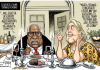











“There are “pernicious effects that inequality has on societies: eroding trust, increasing anxiety and illness, (and) encouraging excessive consumption”. It claims that for each of eleven different health and social problems: physical health, mental health, drug abuse, education, imprisonment, obesity, social mobility, trust and community life, violence, teenage pregnancies, and child well-being, outcomes are significantly worse in more unequal countries, whether rich or poor.”
The Spirit Level: Why More Equal Societies Almost Always Do Better
Richard G. Wilkinson and Kate Pickett.
Exhibit A: The United States Of America circa now compared with circa 1980s.
And the republicans want to make even more inequality thinking it will make them richer.
They haven’t realized that you truly become wealthier by having a piece of an ever increasing pie that’s growing larger for everyone, rather than greedily trying to snatch a bigger piece of a smaller pie just for yourself.
Max at UNFTR has a video this morning that explains the underlying weakness in the labor market and the key inflation numbers in food and rent. This is a “push” type of inflation caused by trump’s tariffs and will soon be exasperated by massive increases in health care costs caused by the termination of ACA subsidies.
On the revenue side of the ledger, trump’s tariffs have brought in little, while hurting manufacturing by driving up the cost of materials. The canary in the coalmine is small business, which is reeling and going bankrupt. So far, the larger companies have been able to swallow increased costs by reducing their margins, but some have been borrowing in the private and largely unregulated capital markets. Some of these lenders have gone under recently, prompting Jamie Dimon to identify them as “cockroaches,” meaning that if you see one …
Then there’s the fallout in agriculture, which is under pressure because of lost export markets for critical commodities like soy, and labor shortages for domestic food production due to trump’s migrant purge. His policies are driving up food costs and imperiling the backbone of US agriculture.
Bottom line: trump’s policies have crippled the economy by driving up the cost of food and materials, cutting off the supply of cheap migrant labor, eliminating export markets for key agricultural commodities, and inflating debt bubbles in the capital markets. The soaring stock market is riding on AI, which only promises to gobble up service jobs and drive up energy prices. Only the oligarchs will benefit, at the expense of everyone else.
And all of this while massively growing the national debt and reducing the income needed to keep a government functioning.