

I know this is not a popular position to take. Insurance companies are, by nature, predators, and health insurance companies are among the worst. Not only are they horrendously expensive, even with the subsidies, but policyholders often have to go into battle to get them to pay the medical bills they’re supposed to cover. The stress is huge, collective and nationwide – no wonder so many want them abolished from the landscape.
But what if an infrastructure were established that collaterally involved health insurance companies contributing to the collective good? As an added incentive, we can design the infrastructure to regulate the companies without written regulations. That instantly saves Congress hours of argument and tiresome amendments. How? Stick with me while I explain.
Let’s first clear the way by binning the whole Medicare-for-all thing. Regardless of how much you love Bernie Sanders & co, we need to be honest at the outset, and honesty requires us to recognise that this tag was nothing more than a politician’s quick and easy label that traded on the familiarity of a known program. But the downside is that it is offering a secondhand solution, which falls far short of what Americans need and deserve.
Sure, I’ve heard the argument that it doesn’t actually mean that the current Medicare program should be stretched to include everyone (though many really do envisage exactly that). If it doesn’t mean that, don’t call it that! So let’s call our state-of-the-art universal healthcare by a moniker that says what we mean. I’m opting for AmeriUniversal (but I’m open to other suggestions).
Funding for AmeriUniversal should be around 2% via taxation on annual incomes above $29,999. Let’s see what that looks like:
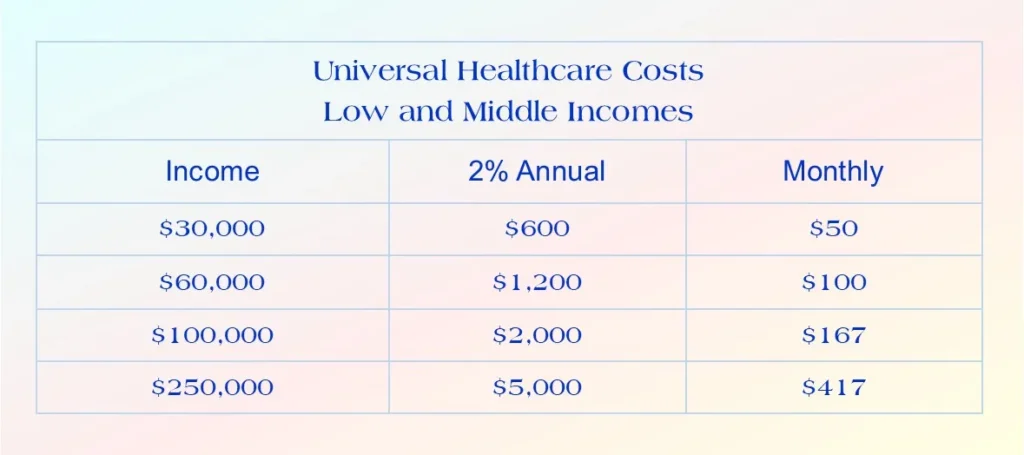
That’s a lot less than the cost of health insurance, and it will cover far more without all the vexation of bills, claims and payments. In fact, AmeriUniversal will be far cheaper for the federal government too, because it will free up funds currently being used for Medicare and Medicaid. Both programs will be retired to the archives because everyone will be covered by AmeriUniversal, regardless of their financial situation.
Everyone, of course, includes millionaires and billionaires who will also be paying 2% of their income towards AmeriUniversal. Let’s see what that will look like:
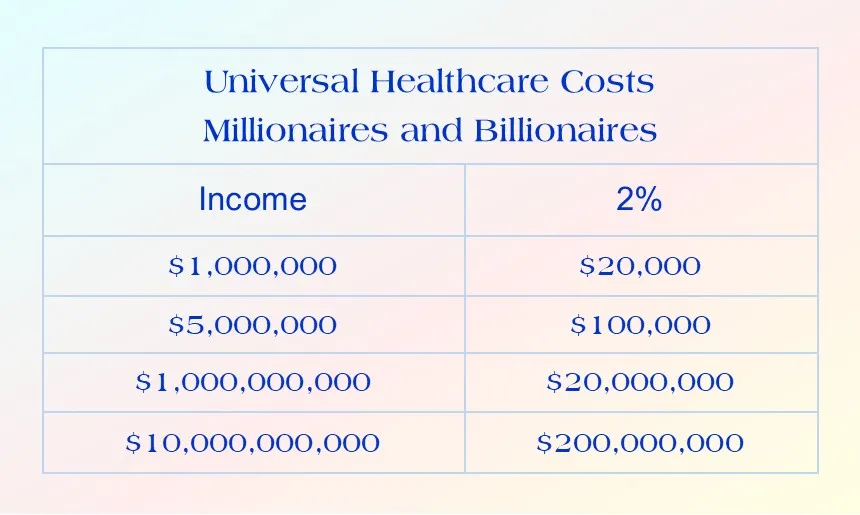
There are an estimated 935 billionaires in the US, and 24 million millionaires. Provided they pay their share, AmeriUniversal will be fully funded.
So what role would health insurance companies play? Hmm, let’s think about this. There’d be a considerably smaller market for their products, which means their costs would skyrocket. Who will buy extremely expensive health insurance? The extremely wealthy will buy it. It will be a status thing. They’ll put stickers on their limosines advertising the fact, and only patronise extortionately expensive private clinics. It will also give them that much-desired capitalist feature: choice.
Best of all, the conceit that drives them to choose whatever is the most expensive in healthcare, and beyond the means of the majority, will actually benefit the majority. Why? Because with all those millionaires and billionaires dropping out of the universal base, there’ll be more AmeriUniversal funds to be spent on healthcare for everyone else. Sweet!
Now for the cherry on top. When the Australian Labor government (Labor being Australia’s Democrat equivalent) introduced universal healthcare, they followed it up by establishing a government health insurance agency. The political architects of this innovation knew that the wealthy would want to stick with the insurance system, so they put the government in the marketplace. It was called Medibank Private, and all the profits went to the universal healthcare program.
Unlike health insurance companies, Medibank Private was run as a government agency. Instead of a CEO and Board of Directors, there was an Agency Head who was paid a government salary. This immediately reduced the costs of MediBank Private’s policies. This instantly caused considerable consternation among the companies because they were being priced out of their own market. To compete with the newcomer in their midst, they too were forced to cut costs.
Then came the terms of the policies. Medibank Private changed that as well. No waiting times, lower out-of-pocket expenses, and comprehensive packages. It must have driven the profit-over-people livid! But they had no choice but to follow suit.
The establishment of Medibank Private caused the entire health insurance industry to change, and without parliament wasting a single minute on writing new regulations to bring it all about.
Australia established its universal healthcare program in 1975, with Medibank Private following a year later in 1976. Given the astounding benefits of a government health insurance agency, perhaps the US should be strategising to begin with the government agency and follow it up with AmeriUniversal.
Just a thought.
You can follow Michelle at Blue Sky: @michelleelle.bsky.social and buy her a coffee at kofi.com.























Medical Bankruptcies in Australia
Still zero. Along with the rest of the developed world.
Life expectancy at birth.
Australia 84
USA 79
The US ‘system’ is slow, expensive, ineffective to the point of lethality in many cases.
But very profitable in monetary terms for the ‘insurance’ companies involved.
To be fair, some sort of ‘free at the point of use’ healthcare system is a very difficult problem to solve – indeed it’s so intractable a problem, that only 61 out of the top 62 world economies have been able to implement it.
I’ll just use myself as an example. Throughout my career I had expensive employer paid, INSURANCE BASED healthcare. When I turned 65 I was retired and immediately switched to Medicare and a very low cost Medicare supplement plan. Guess what else changed? That would be NOTHING. I had the same doctors at the same healthcare clinics and hospitals. Well, one thing did change, I no longer had a single out of pocket co-pay EVER.
The fact is, Medicare not only works great, it eliminates practically all insurance company bloat and bullshit. So, please tell us, just WHY wouldn’t this great system work for everyone, not just those those over 65 or qualify via other means? You article makes zero case otherwise.
The whole concept of “insurance” in healthcare is idiotic. Insurance is intended to defray risk of catastrophic loss. Healthcare costs across the population mostly involve healthcare MAINTENANCE. Having insurance companies with their CEOs making 10s of MILLIONS of dollars per year in our healthcare system make ZERO sense on ANY level.
The other big flaw in this article is the assumption that the super rich report taxable incomes of millions to billions of dollars per year. They do NOT. In fact, many, if not most of the super rich report nearly no income each year. Their wealth is in equity ownership and often provide “income” for themselves by borrowing against that equity – NOT taxable.
Look, I can afford any fancy insurance based healthcare plan I want. But I still CHOOSE to be on Medicare. Why? Because I get the SAME healthcare without shoveling my money into the pocket of some super rich insurance company CEO. There is no reason we can’t make the same federal healthcare for EVERYONE. I’ll even let you name it with whatever you want if that is so important to you.
Does Medicare include dental care, physio, podiatrists, dietitians, cardio gym and lifestyle classes? I’m glad you’re finding Medicare meets all your needs, but that isn’t true for everyone. It wasn’t designed to be a universal healthcare program, and I doubt it has the infrastructure to serve everyone.
As for your complaints about health insurance companies, I agree with you. Nothing I’ve said about them disagrees with your opinion.
Of course, not all wealthy people will buy health insurance, but the point is that the companies will be reliant on those who will. No government funding will be propping them up anymore.