
It wasn’t until I recently checked the finalised results of the Alaskan primaries that I realised, with glee, just how smart the state’s Democrats are. Unlike Republicans, whose egos impede their ability to make decisions involving personal sacrifice, Alaskan Democrats have learned from observation and experience how to work the RCV (ranked-choice voting) system.
Alaska adopted RCV in 2022. That’s the year Democrat Mary Peltola became the first native Alaskan to win a US House seat. She’d won the special election to replace the late Don Young on August 16 of that year, and was instantly back on the campaign trail for the midterms. There she faced Republicans Sarah Palin and Nick Begich, the same two candidates she’d beaten in August, and beat them again in November with an even larger majority.
Mary lost the seat in 2024, but several factors were operating at the time, including personal tragedy in September 2023 when her beloved husband, Buzzy Peltola, died in a plane crash. Though Congress was deprived of a dedicated and well-liked member, Mary was given a break she probably needed in the circumstances.
Two years later, Mary Peltola is back, this time running for a Senate seat, and the odds are stacked in her favour. Even better, her race is not the only one in which Democrats have the advantage. Alaskan Democrats are using what they learned in 2022 and 2024 – that they have a greater advantage when there are fewer of them in the contest and more Republicans – and they are now applying it across the board in 2026.
The first change Alaskans made when they embraced RCV was to replace party primaries with a blanket primary of all candidates, regardless of political identity. RCV then selected the top four candidates to advance to the midterm ballot. Let’s compare Democrats to Republicans in three Alaska 2026 primaries: Governor, US Senate and US House At-Large.
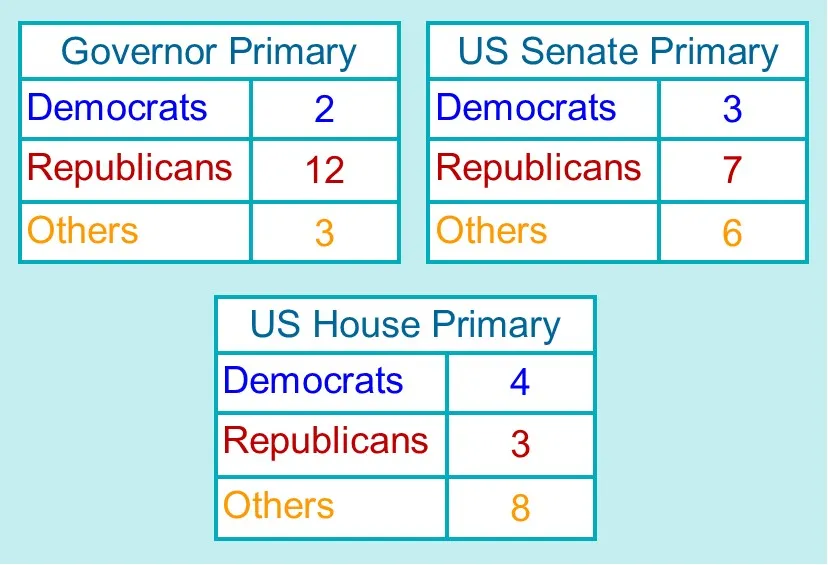
In the Governor and Senate primaries, Democrats gave themselves a clear advantage by limiting their entries to fewer than Republicans. In the House primary, however, they had one more than the Republicans, but that disadvantage was reduced by the inclusion of two Libertarians, who bolstered the overall conservative number.
How well did this work out for Democrats? Let’s begin with Mary Peltola’s race. The New York Times results are on the left, with my summary on the right.
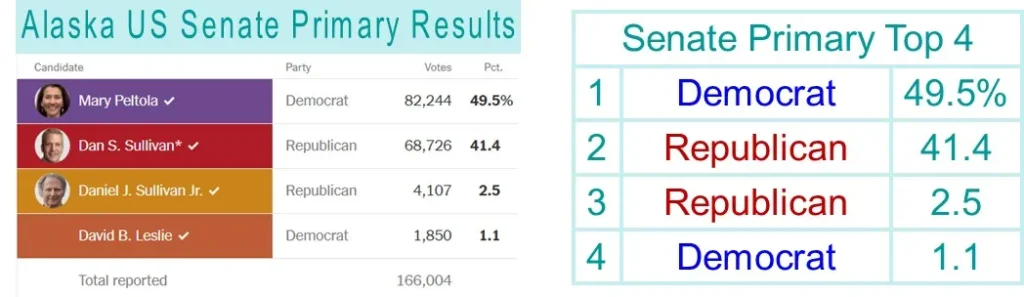
Mary Peltola came within half a point of garnering 50% of the vote to take poll position in this primary. The other 15 contestants divvied up the remaining 51.5% between them. While this was a cause for cautious celebration, the more vital statistic was the Democrat finishing in fourth place, to balance out the numbers of Democratic and Republican finalists.
But balance is not what Democrats need on a midterm ballot. David Leslie understood the need to stand aside and immediately withdrew his candidacy. That allowed fifth-place Republican Jerry Heikes to move up to fourth place and claim the last position on a midterm ticket that now features three Republicans and one Democrat.
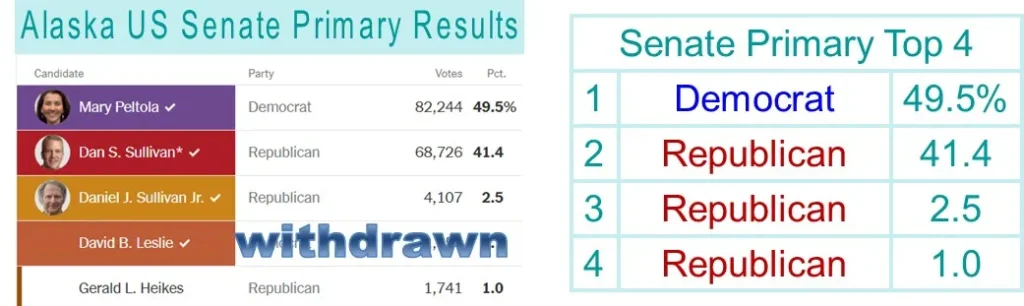
Yay! This makes it possible for Peltola to win 50%+1 of first preferences, thereby gaining the win outright. Thank you, Dave Leslie!
Now, the US House At-Large primary results.
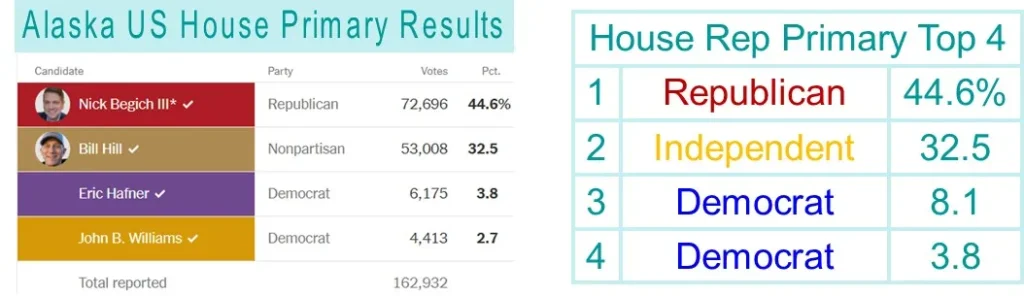
Contrary to the New York Times graphic, Democrat Matt Schultz placed third with 8.1% of the vote, but he withdrew before counting concluded. From the Anchorage Daily News:
Schultz, a pastor from Anchorage, entered the U.S. House race in October, running on a progressive platform.
He announced he was ending his campaign in email Friday, referencing a recent move by the National Republican Congressional Committee to sway the result of the state’s primary election.
The Anchorage Daily News explained that Schultz was referring to underhanded tactics being practised by a bumbling NRCC desperate to hold onto its slim majority:
The announcement came after the NRCC earlier this week called on independent expenditure groups to run advertisements promoting Schultz.
“Democrat primary voters need to see and read that Matt Schultz is the Democrat they can trust,” the NRCC wrote in a message posted to its site earlier this week. Such messages are typically targeting political action committees with the funding to run ads echoing the proposed language.
It’s part of a strategy being used by Republicans to use shadowy groups to intervene in Democratic primary contests by spending money to elevate candidates that they see as easier to beat.
In his email, Schultz wrote:
“We are living through a moment when our democracy itself is under threat, and defeating Nick Begich and restoring a Democratic majority in the House must come before any one candidate or campaign.”
“It has become clear to me in recent days that remaining in this race no longer serves that urgent purpose. Today, I am suspending my campaign and calling on Democrats, Independents, and all Alaskans who believe in protecting our democracy to vote for Bill Hill in the general election this November,” Schultz said.
Respect.
There followed three more withdrawals in quick succession until eighth-place Libertarian Jim McDermott rocketed up to fourth position and a place on the midterm ticket.
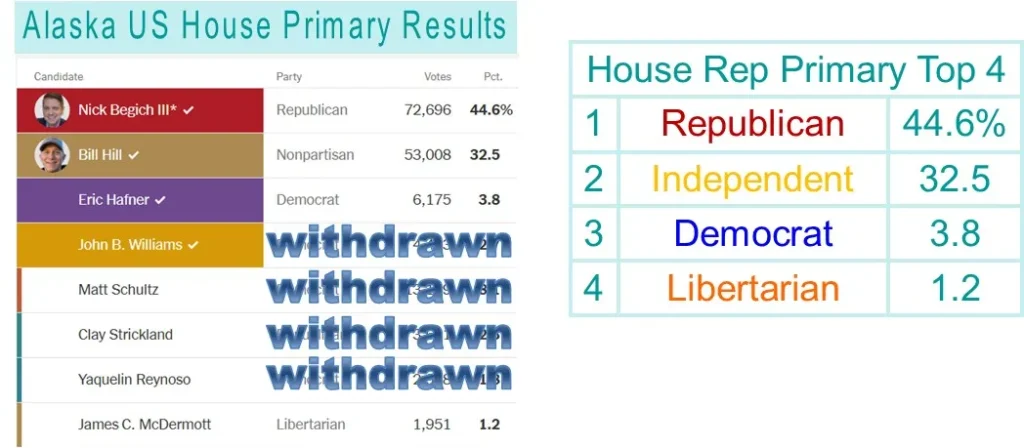
One Democrat, the original fourth in the primaries, remained in contention, but with a vote percentage of 3.8, his only contribution is likely to be as a second-preference booster for Bill Hill.
The race for Governor is even hotter for Democrats than the Senate race, and murkier for Republicans than their NRCC shenanigans. This is how it looked at the end of counting:
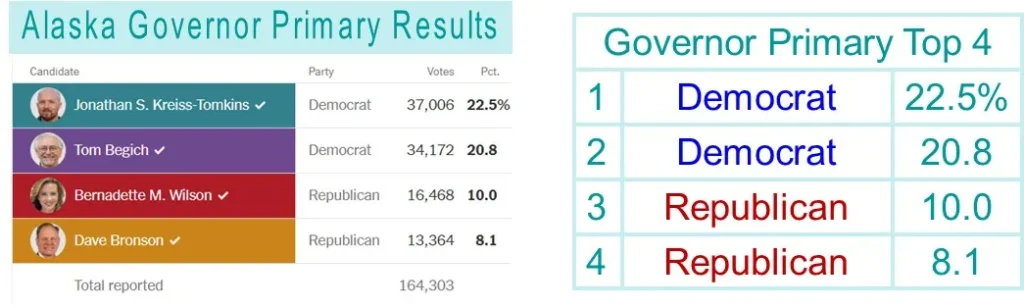
Again, two Democrats finished in the top four, but this time they each had more than double the votes of the highest-placed Republican. Nevertheless, it still stands that the advantage goes to the party with the least number of candidates on the ticket. Kudos to Tom Begich, who withdrew so that all Democratic votes would flow to one candidate, Jonathan Kreiss-Tomkins.
Fifth in the primary was Treg Taylor, but he wasn’t destined to fill the vacant fourth spot. Alaska Public Media explains:
Former Alaska Attorney General Treg Taylor will not appear on the November general election ballot after Lt. Gov. Nancy Dahlstrom declined Monday to certify his nomination on the recommendation of the state’s campaign finance regulator.
The Alaska Public Offices Commission found by a 4-1 vote Thursday that Taylor did not “substantially comply” with financial disclosure requirements ahead of a July 1 deadline by failing to name tenants who paid rent at an apartment building he owns in Anchorage.
Lt Gov Nancy Dahlstrom commented in her statement that the law was clear – actually, she said the law was not unclear, and by that, it was clear that she meant it was clear rather than unclear. Okay, moving on…
The decision allowed Taylor’s running mate, Candi English, to take his place, meaning English is set to advance to the November ranked choice general election for governor. English selected Taylor’s wife, Jodi Taylor, as her new running mate, her campaign said Monday afternoon. Neither has previously held elected office.
The adjusted results in the Governor’s race look like this:
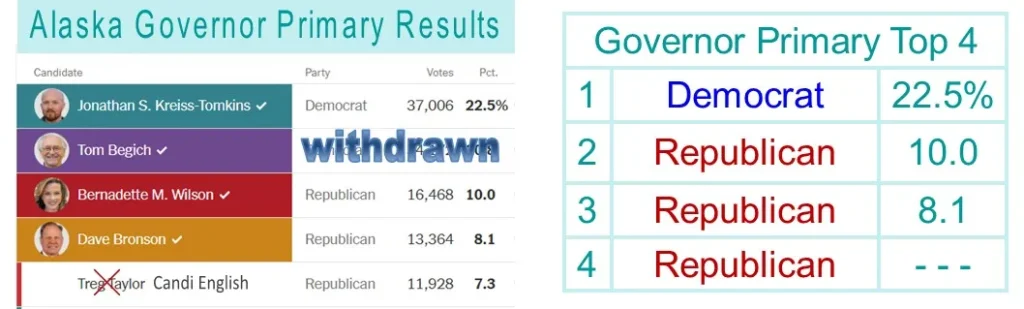
Democrats are well-placed in the Senate and Governor contests, with Independent Bill Hill having an outside chance in the House At-Large race. It helps that Alaska really likes Mary Peltola because Congress needs her back in DC.
It helps too that Republicans are still operating on pre-RCV strategies and bumbling schemes while Democrats understand the assignment. In a recent interview, Tom Begich said,
“The data showed that the ability to change the direction of the state of Alaska was significantly better if there was one rather than two Democrats in the race.”
Tom Begich put his state first; David Leslie and Mark Schultz put not only their party but the good of the nation before themselves. That’s Democratic altruism at work.