
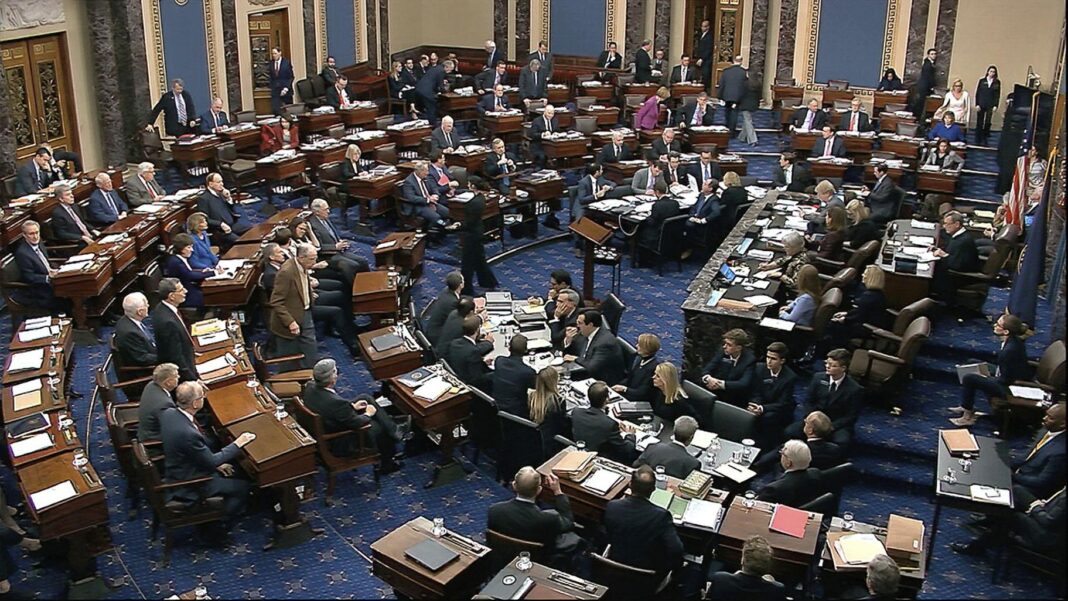
I’m glad to know that I’m not the only person who came to this conclusion back on election night last week. Jonathan Cohn has also reached the same place. We’re talking four seats to take back the senate, not ten, not fourteen, which is not an outrageous proposition; espeically considering the fact that the electorate sent a screamingly clear message last Tuesday about change being in the air and the GOP going down the tubes. Also, the Trump era has seen a lot of resignations and retirements, which makes sense in the overall context of the changing face of both chambers of congress. Cohn’s premise is that a three-way contest for the senate nomination in Michigan is a mircrocosm of the debate over the Democratic party’s future as a whole and what roadblocks there could be.
THE BIG DEMOCRATIC WINS LAST TUESDAY mean control of the Senate could really be in play next November.
That is why—as my colleague Lauren Egan reported last week—Democrats are talking seriously about states like Alaska, Iowa, and Ohio, where, in a strong year, they could flip seats now held by Republicans.
But Democrats won’t have a shot at a majority if they can’t defend seats they already hold. And in at least one state, that’s no small thing. That state is Michigan.
Incumbent two-term Democratic Senator Gary Peters announced in January that he would not seek another term, following in the footsteps of longtime Michigan Senator Debbie Stabenow, who had announced her retirement before the 2024 elections. Stabenow’s decision was a conscious, deliberate attempt to hand off leadership to a new generation of Michigan Democrats, and the plan worked seamlessly.
The 2024 Democratic field cleared for Elissa Slotkin, who had already parlayed her bipartisan credentials and national security experience into a string of victories in red-leaning House districts. Slotkin went on to win the Senate seat even though Donald Trump carried Michigan in the presidential election.
This time around, things aren’t going to fall into place so neatly.
Three Democrats are seeking the party’s nomination, each formidable in his or her own way. One is a generational orator who thrills the party’s progressive base. Another is a breakout national star who first won acclaim by punching back at Republican bullying. The third is an industrious, widely respected legislator who can honestly say she played a role in saving Michigan’s auto industry.
But each one also has big questions hanging over their candidacies. Can a Bernie Sanders–styled progressive win such a decidedly purple state? Can the national media darling connect with Michiganders as well as she has with MSNBC audiences? Can that industrious legislator survive in a political era that puts a premium on the ability to get and sustain attention?
The anxieties about these candidates tap into broader doubts Democrats have felt about their party ever since Trump won last November. That’s one of the reasons the Michigan race is so important nationally: It’s a microcosm of the larger debates about how the party should position itself. And the decision Michigan’s Democratic primary voters make—as they weigh not only their own preferences but try to pick a candidate who will resonate with the full electorate—may give us hints of what to expect nationally in 2026 and 2028.
The good news for Michigan’s Democrats is that the political environment for 2026 seems likely to be favorable, given Tuesday’s wins and the general tendency of midterms to be bad for the president’s party. Plus, the last time a Republican Senate candidate won in Michigan was 1994, and this time the nominee is likely to be Mike Rogers, the same establishment Republican and Trump-critic-turned-supporter who lost to Slotkin last year.
The way the political weathervane is blowing is away from extremism. Trump and the right are the extremists now. Centrist Democrats are the way of the future. Josh Shapiro and Gavin Newsom are both candidates that could win and Pete Buttigieg could be a candidate for VP. I hope. It is a galling factor to me that a political talent like Buttigieg exists yet is shunted to the side because he happens to be gay.
Again, this is one of those situations where America proves how primitive a culture she is. We have seen an openly gay man as the Prime Minister of Ireland, we have seen woman in charge as Prime Ministers and presidents in countries such as Japan, Mexico, and the UK. But something in the American DNA keeps us from taking that kind of a step at this time.
Maybe 2026 will be the year that that barrier gets broken. But nevertheless, we have a roadmap now. We have the people. We just can’t screw up the message. Trump isn’t going to get any saner and this administration is not going to get any less volatile.
The rest of Cohn’s article is an indepth analysis of the actual individual candidates involved in the crucial Michigan seat. Read and bookmark it because some of those names will be showing up as the next year goes by. We can retake both chambers of congress and now is the time to start thinking that way.























We’ve already seen that Americans can’t accept a woman as President. Rightly or wrongly, (and it is very wrong), a gay man is at least a decade away from running successfully for President.
But I’d love to be wrong.
If “centrist Democrats” are the wave of the future, it will only be because the definition of “centrist” has moved quite a bit to the left.