
As was predicted before Trump 2.0 commenced earlier this year, bad thinigs are happening that will have massive impact upon this country long after Donald Trump is ashes. His stupidity will live on way beyond him. The story that broke earlier this week is a blockbuster and if we had somebody like Ben Bradlee running the Washington Post, it would have been treated as such. But it, too, is sailing under the radar like so many key stories nowadays.
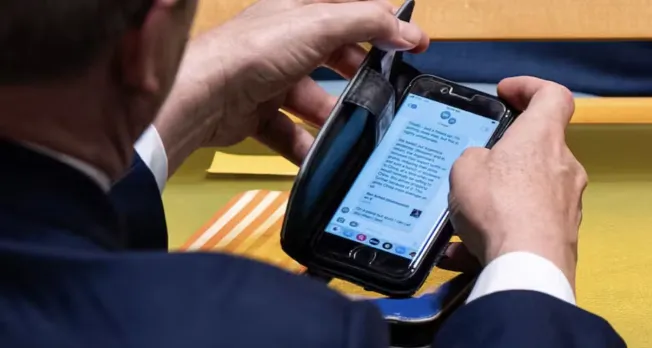
Here’s what actually got into the news. A camerawoman managed to take a shot of Scott Bessent’s text. The content of the text is what’s important. Because that unveils the story of how China is playing a strategic game of which Trump is unaware and he’s playing right into their hands.
Treasury Secretary Scott Bessent was spotted at the United Nations General Assembly last week reading a panicked message from “BR,” who some have determined to be Secretary of Agriculture Brooke Rollins. The message linked to the X account of Ben Scholl, a midwestern grain trader who has sounded the alarm on Washington’s newly-tossed lifeline to Buenos Aires.
“Just a heads up. I am getting more intel, but this is highly unfortunate. We bailed out Argentina yesterday and in return, Argentina removed their export tariffs on grains, reducing their price to China at a time when we would normally be selling to China,” the message read.
“Soy prices are dropping further because of it. This gives China more leverage on us,” the message continued, with Rollins adding: “On a plane but scott I can call you when I land.”
The photograph, taken by photojournalist Angelina Katsanis for the Associated Press, has already circulated through Argentine news.
Last week, Bessent pledged that the United States was “ready to do what is needed within its mandate to support Argentina,” which was a “systemically important U.S. ally in Latin America.” He said that U.S. officials were in talks to establish a $20 billion swap line with Argentina’s Central Bank—an institution Argentine President Javier Milei once promised to abolish—and purchase secondary or primary government debt. Bessent even hinted at handouts from U.S. companies.
Scholl argued that this was a huge mistake. “China and Argentina work together for soybeans as Bessent offers to subsidize the Argentine economy,” Scholl wrote on X Tuesday. “They think you are stupid.”
China, the largest buyer of U.S. soybeans, has not purchased any American soybeans since May, pivoting to suppliers in Argentina and Brazil as Trump struggles to land an actual trade deal with Beijing. Even top Republicans have been forced to admit that Trump’s tariffs have created a squeeze for farmers, one that the president said could be offset with “millions” or “billions” of tariff revenue—he wasn’t actually sure.
“The U.S. trade war with China has dealt a huge blow to American soybean producers, since China paused soybean imports from the U.S.,” Rohit Chopra, former director of the Consumer Financial Protection Board, wrote on X Monday. “But this may not be temporary, as Argentina and other countries cut deals with China to cut America out of the business.”
“The Treasury Secretary should: (1) Immediately hit pause on this inappropriate bailout of Argentina that is further harming American farmers (2) Affix a privacy screen to his iPhone, available online and in stores for roughly $10,” Chopra wrote in a separate post.
The Democrats need to message the hell out of this in advance of the 2026 midterms. This is the beginning of what could become a domino effect. Nothing ever falls apart all at once. Nothing big, in any event. Usually there’s an event that kicks off a major disruption and then if that event isn’t dealt with, the entire infrastructure of a given institution can start to wobble.
Trump has zero concept of anything having to do with foreign affairs. All he knows how to do is sell out the United States to swell his own coffers. Unfortunately, the stupid choices his administration is making right now are going to be with us for years to come.









First of all, we the people including reporters especially the kicked out AP, do not want privacy screens on cabinet members phones!
Secondly, Bessent said pay off deficit with tariffs proceeds before farmers, meaning no bailouts and thirdly, the farmers and these are large ones not the smaller farms should b doing the same as China since May to find a deal with another country instead of whining that their vote for Trump was a vote for China and asking for another fucking Trump bail out.
Finding markets for American farm products is the job of the goddam government, not farmers. Some farmer, no matter his acreage, can’t just call up a foreign government and ask it to buy his wheat. Would that things were that simple.
You are right that farmers don’t sell directly to foreign buyers (with rare exceptions for farmers who also produce speciality products for sale). Understanding how the Agricultural economy works and how the government is supposed to work to support it is crucial to understanding the full extent of President Trump’s failure and betrayal.
In the case of commodities like soybeans, farmers sell to local elevator companies or farm co-ops, these sell to large exporters like Cargill, Archer Daniels Midland, and others. These large exporters make the actual sales, arrange shipment, financing, insurance, and documentation. The foreign buyers which include direct processors, foreign government agencies and state owned businesses, and importers that arrange sales and distribution nationally. Note that much of what the Federal government does (see below) is aimed directly at helping the actual exporters and importers which indirectly benefits the farmers.
Under law, the U.S. government supports agricultural exports through the USDA’s Foreign Agricultural Service (FAS) and other agencies. The Federal government has a number of key roles including removing trade barriers, and providing export financing and risk mitigation to help US exporters and foreign buyers. The government plays a more active role in removing financial risk of sales to developing countries, historically including China which accounts for 40% – 50% of recent soybean exports, promoting exports through programs like:
– Market Access Program (MAP): provides cost-share funding to U.S. agricultural trade associations, cooperatives, and state regional trade groups to conduct overseas marketing and promotional activities for branded and generic products.
– Foreign Market Development Program (FMD): focuses on longer-term foreign market development activities to address foreign import constraints and identify new markets or uses for generic U.S. agricultural commodities.
– Export Credit Guarantee Program (GSM-102): Provides payment guarantees to encourage commercial financing of U.S. agricultural exports
The government also offers market intelligence and technical assistance to help U.S. producers (end to end from farmers to exporters) compete globally. Farmers also can receive direct and indirect financial assistance from the Federal government.
The impact of Trump’s ill-considered tariffs goes far beyond farmers, dragging down the entire US agricultural supply chain and everyone who supports it. These impacts are not isolated to a one time shock and can include long term loss of market share, reduced sales for local businesses, farm machinery manufacturers, tax revenues for State and local governments and layoffs across America from teachers, to bankers, to local stores, to engineers, to truck drivers, to the people who build and service farm equipment. And the impacts don’t stop there – with fixed costs spread across a smaller total market, prices for food here in America are likely to increase as well.
President Trump betrayed rural America with his tariffs not simply by imposing taxes which will both tend to increase prices and constrain investment in American competitiveness but by destroying key markets for US agricultural products. We have the data to show this problem is real. We need to see if the poison Trump injected into the agricultural markets will spread to other export markets that have different timelines.