
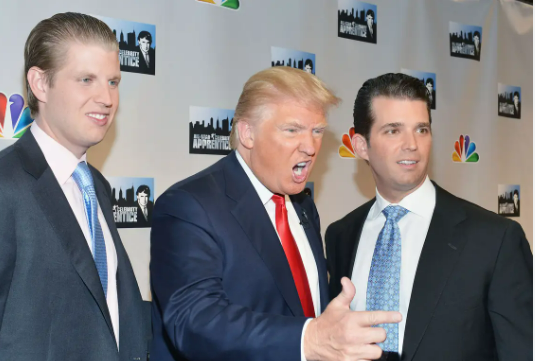
Intriguing how this $175M bond of Donald Trump’s has exploded into high drama the past several days, isn’t it? Generally speaking, news of a bond being posted is somewhere on the excitement scale of watching cement harden or paint dry. But not this bond. And today it’s going completely over the top with one of Trump’s lawyers crying “witch hunt” and his son Eric braying “absurdity” and “foolishness.” Hey, Eric, if the company is solvent, then it’s no biggy, right? Why are you sweating it? Unless maybe you know there’s going to be a problem?
Justice Arthur Engoron, in an abundance of caution, is holding a hearing on April 22 after Letitia James’ office questioned whether Knight Specialty Insurance Company “is financially qualified to handle a bond of that size,” according to ABC News.One problem might be that the California company is not registered with the New York Department of Financial Services. Most of the big players in bonds and indemnifications of this nature are registered in New York, so this is perhaps not a red flag, but it’s something that bears looking into. Unless of course there’s some reason the Trump family doesn’t want anybody looking too closely into this company and why oh why might that be?
In a brief interview with ABC News, the chairman of Knight Specialty’s parent company, Don Hankey, said he had “no concerns at all.”
“Seldom do our applications or our bonds get turned down,” said Hankey. “I imagine it is being scrutinized very carefully, and they’re checking to make sure all the I’s are dotted and the T’s are crossed.”
And that’s as it should be, right? This is a big case, high profile defendant, and the attorney general is doing her job. But not according to one of Trump’s lawyers, naturally.
Trump’s defense attorney, Christopher Kise, blasted the attorney general for questioning the surety.
“Yet another witch hunt!” Kise said in a statement provided to ABC News. “After hiding out in silence following an embarrassing loss in the First Department … the Attorney General now seeks to stir up some equally baseless public quarrel in a desperate effort to regain relevance.”
No, I think there’s a little more substance to this decision than that, Mr. Kise. Even the Wall Street Journal weighed in on how odd it was this company was involved, according to Seth Abramson.
In the last report on the ongoing Trump Bond Crisis—the Purple Report—readers were introduced to a number of self-described surety experts on social media who questioned whether Hankey and his company even had the authority to participate in the surety industry in New York. The nation’s paper of record on financial matters, the Wall Street Journal, has now weighed in on this:

The language governing Treasury Department listings, as Proof noted in the Purple Report, isn’t exactly as Nicholas Newton contends it is, above. Both Dave Kingman and Brad Cox indicate that federal projects beyond construction projects are governed by the language requiring state-by-state surety-firm certification, and certainly on the face of things—that is, per the plain meaning of the relevant regulations—that’s right.
This may be why the Wall Street Journal makes use of the qualifier “likely” in detailing Newton’s contention that Trump and Hankey face no regulatory hurdles in getting their bond transaction through a vigorous court review in New York state.
Perhaps more notable, however, is Newton’s confirmation that the surety must be broadly “acceptable to the court”—a decision the court might have slightly more leeway in engaging when the surety firm in question (with Newton here confirming the exclusive Proof reporting from yesterday) “doesn’t even make the list of firms approved by the Treasury to issue so-called surety bonds.” As a former trial attorney I know a judge might well ask, in this instance, “Why did you stand in my courthouse lobby and say you would pay your bond in ‘cash’, Mr. Trump, only to then seek an opaque arrangement with an entity not licensed to be involved in this industry at all?”
Such an idiosyncratic development in a case where the defendant has been found to have repeatedly lied about his finances is unlikely to please the court and—if the New York Attorney General’s Office should add its voice to any chorus of protest over this latest Trump bond—it certainly might lead to a “show cause hearing” at which Trump and his legal team would be asked to say more about how this bond came about, with the NYAG then free to make a robust record of all the things wrong about the transaction.
And as we’ve seen, there are quite a few things wrong here, none of which it seems the principals in the transaction have been honest about with anyone.
{Note: Late in the evening of Tuesday, April 2, 2024, NBC News posted an update to its past reporting on the Knight Bond that reveals that Hankey “was negotiating to post a far heftier bond of $557 million with the Trump Organization when the state Appellate Division lowered the required bond to $175 million.” This increases by more than $100 million the total amount that the Knight/Axos corporate axis was willing to loan to Trump to well over $1.1 billion, and that doesn’t even include any loans made to Jared Kushner. Keep in mind that Axos isn’t even one of the nation’s hundred largest banks, and that Knight is considerably smaller than Axos.}
In short, you can see that there are a lot of questions that need to be answered. And this is why Trump world is going banana bonkers today.
Where is the PROOF of that 100% and where, ultimately, does the cash come from? From whom? He's running for President of a country; who, of all his debtors, will be running HIM? And if he loses, who will be tendering that cash to the state? Why the reluctance to answer clearly?
— Larkin Warren (@LarkinWarren) April 4, 2024
And if it was a cash transaction and Trump was able to easily put up that kind of cash, then there won’t be a problem. The State of New York will receive assurances, the judge will be happy, the attorney general will have done her due diligence and all will be well. But guess what? It doesn’t appear to be so cut and dried as Eric would have you believe. Back to Seth Abramson:
What changed between the moment Team Trump turned away from working with Hankey to it suddenly returning to him and asking him to do what it could have asked him to do during their earlier conversation? Is there some reason that Trump wanted to avoid working with—or being seen to work with—Knight and/or Axos if possible?
Was there some material change in Trump’s capacity or his willingness to put up $175 million in cash (put directly into escrow with the court) between the first conversation between Hankey and the Trump Organization and the second, or in any case between a call that ended in “goodbye” and one that ended with Hankey saving Trump from ruin? If so, what was that material change and why does Trump now wish to hide it?
Certainly, we know from a CNN report that Hankey “doesn’t know where the $175 million in cash that Trump posted came from”, though presumably it’s a question he might have thought to ask—as an experienced lender interested in due diligence—when a man who had just told him on a Monday that he had $35 million suddenly called back days later to say that he actually had $175 million to work with right now.
So why, given all the foregoing, does Fortune report that Hankey told the Associated Press that “both cash and bond were used as collateral for Trump’s appellate bond”?
By the time of his AP interview, Hankey was well aware the deal had changed to cash-only. Was he confused about whether he was supposed to hide from the press—maybe for Trump’s sake, though we know not why—that Trump had more money available to him than he’d anticipated having just days earlier? Is there indeed, behind this Knight Bond, a sudden Trump windfall of liquid assets that everyone involved in the latest Trump bond transaction are trying to synchronize their stories to better obscure?
That certainly seems to be the case, given Hankey’s shifting explanations of the deal’s terms. As for Trump, Fortune helpfully reminds us that this entire case arose because of “Trump lying about his wealth.” Did the former president do exactly that again, here?
Who knows? But I think Justice Engoron might want to find this all out. What occurs to me right now, is how is Trump going to be two places at one time? His hush money trial starts April 15 and since it’s a criminal trial he can’t just phone his appearance in. So we presume he’ll be there. Maybe Trump’s lawyers will attend the hearing on April 22.
Trump’s legal problems do seem to be compounding.



















“And as we’ve seen, there are quite a few things wrong here, none of which it seems the principals in the transaction have been honest about with anyone.”
So, just the usual Trump Hankey panky, as expected.
No snake slithers in a straight line. Trump is incapable of honesty in any statement or financial transaction.
Whether Mr. Hankey has concerns or not is irrelevant. He could realize there is jack sh*t backing this bond and is just trying to pull a fast one and allow trump to as well. The real issue is whether Ms. James or Judge Engoron have concerns. It they are doubtful then the doubts need to be cleared up. Period. When he loses his appeal there needs to be a significant amount available immediately for Ms. James. The rest will be obtained when she finds what, if any, assets are left to trump.
I see a scenario where Trump tries to pay back Mr. Hankey in Trump Poo. Unless Mr. Hankey really has him by the short and curlies, he’s going to learn what thousands have learned about doing business with Trump.