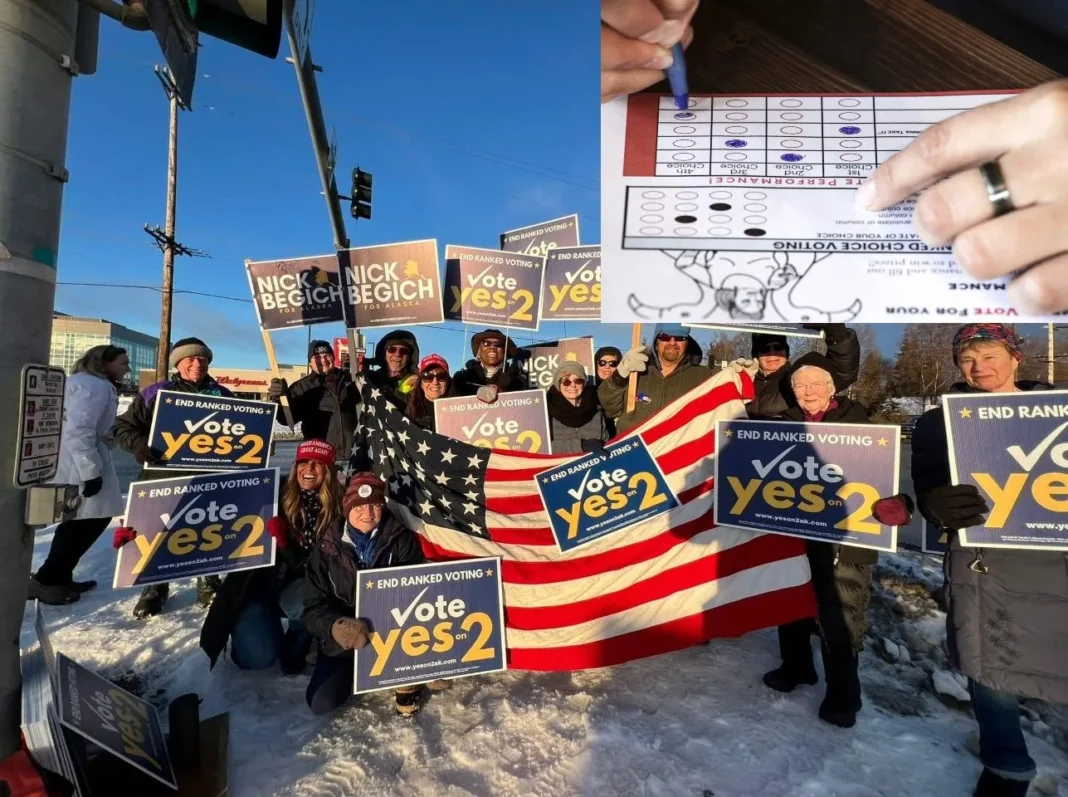
Ranked Choice and/or Instant Runoff Voting in the U.S. is mostly at the state and local level, and in primaries for higher offices in some states. Alaska is one of the few places where it is used in statewide races or in federal general elections. Voters approved their system in 2020 and it was first used in 2022. In 2024 opponents got a measure on the ballot to drop the brand new ranked choice voting system. They tried again in the 2026 midterm election. And lost again, AND by a wider margin!
Opponents of ranked choice say it’s too confusing. For the second time in two years a majority of Alaska voters have said ‘No, it’s not.’ As Newsweek reports Ballot Measure 2, a referendum on whether to stick with the voting system that’s been used in the last three primary and general elections passed:
Unofficial results released by the Alaska Division of Elections on November 13 showed 53.52 percent voting against repeal and 46.48 percent supporting it, a lead of 18,655 votes.
Ballot Measure 2 would have restored party primaries and general elections in which voters choose just one candidate. It also sought to repeal campaign finance rules intended to identify the sources of political donations.
For all the hoopla about the two Dan Sullivans on the Senate ballot and voters in Alaska being too stupid to understand the clear distinction about which was which on the ballot the fact is voters in that state are sharper than those from “outside” (a term of art in Alaska I learned during a visit there decades ago) think. This is a state where the voters re-elected Senator Lisa Murkowski using the Write In process. Think of it like this: Write in campaigns almost always fail, usually because a candidate doesn’t have a high enough profile and record. Murkowski didn’t have to overcome that barrier. She had however lost in the GOP primary so she had to mount a campaign to ensure voters knew all about the write-in option. In any race anywhere something as trivial as a single letter misspelled in a candidate’s name will disqualify a write in vote. MURKOWSKI. Plenty of ways to get that wrong, yet the voters were smart and careful enough to override the hard-core primary voters and keep Lisa Murkowski in the Senate.
That folks is why all the fuss over two Dan Sullivans was manufactured outrage. Voters in Alaska saw right through it, and it seems were bothered enough by it to solidly vote to retain ranked choice voting! It might at first glance seem complicated but it’s really not. Voters have a given number of candidates on the ballot – in the Alaska general election the top four vote getters from their ‘jungle’ primary were on the ballot this year. A voter can vote for only one candidate, or they can vote for more. All four in fact, noting their first choice, second choice and so on.
If no one has at least 50% when the ballots are counted the candidate with the fewest votes is eliminated and the counting software adds their next choice(s) in order of preference to the remaining three. If no candidate is at 50% at that point, the bottom vote getter is again eliminated and their vote is assigned to the top two in order of preference. If a given race gets kicked to ranked choice a computer command does the whole thing in seconds and a winner is declared. IF no one gets at least 50% in the first place.
In the key races, for Governor and Senator using the ranked choice tabulation method might not be necessary. In the Governor’s race Democrat Jonathan Kreiss-Tomkins had garnered 50.81 percent of the votes as of the Nov. 13 ‘first count.’ Republican Bernadette Wilson has conceded, so that’s settled and Democrats have officially flipped another Governorship. With the Senate race it’s still uncertain although according to this article from MS NOW as of this morning Democrat Mary Peltola is really, really close to the magic number of 50%:
With 20,000 more votes added to the statewide tally early on Saturday, Peltola is poised to likely triumph over Republican Sen. Dan Sullivan when votes are expected to be finalized next week.
The Associated Press has not yet called the race and there is no official winner.
Peltola remains under 50% of the vote — at 49.8% — and a ranked choice vote tabulation is still possible next week. Alaska has until Nov. 18 to finalize its election results after all ballots are processed, including those sent from overseas.
MS NOW goes on to note that ballots arriving since election night have trended Peltola’s way so while Nov. 18 is when they can activate ranked choice it might not be necessary. While the race hasn’t been called it’s now rated as “Likely Democratic” meaning yet another flipped (to Democrats) Senate seat and a strong 56-44 majority! Of course that doesn’t mean Dan Sullivan (the GOP nominee) will concede. He might choose to, despite failed court challenges (over the second Dan Sullivan being on the ballot) make one last, desperate try. You can be sure Trump and his puppets at the RNC will be pushing that angle. Sullivan however might want to preserve his future in Alaska politics.
Experts say any legal challenge based on who was listed on the ballot will fail. Add that to voters clearly rejecting ranked choice voting and it won’t be a good look for Sullivan if he wants to run for office again. We’ll have to wait and see but while I try to be careful about proverbially counting chickens it seems safe to say ranked choice voting is here to stay in Alaska, and that Mary Peltola will be the first Democrat to represent the state in the Senate in a very, very long time.
Friends, I know everyone begs you for money. I promise, among all those asking for spare change, we are the smallest and the hardest working. We’re a group of old, disabled people, except for one writer in his mid-50s. The rest of us are in our sixties and seventies, and this is a labor of love. All we’re asking for is the chance to keep telling the truth about Trump and help ensure democracy survives. If you can help, please do. Thank you. Ursula