

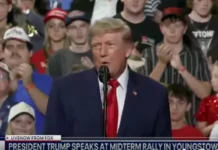
This is a forest for the trees kind of a thing, because the topic at hand is nothing new. It has been with us the entire ten dreary years that Donald Trump has been polluting our politics. But the framing of it is new and Trump himself provided the opportunity to see this new framework just a few days ago when he did his disastrous address to all the assembled generals. Without exception, the *reviews* of that debacle have been uniformly negative. On the optimistic side, none other than the New York Times picked up on this new framework, and that is hopeful, because if the Grey Lady has decided to switch tactics in how Trump is covered, we may indeed be seeing a shifting of the political weathervane — or at least a shift in how Trump is covered from here on out and that would provide a much needed breath of fresh air. Check out John Stoeher’s column today.
I could be wrong, but JB Pritzker may be the first Democrat to apply the d-word to Donald Trump. More importantly, the Illinois governor may be the first to link his criminality to his dementia. And! He may be the first to explain America’s existential crisis in context of a remedy.
A threefer! He said:
“It appears that Donald Trump not only has dementia set in, but he’s copying tactics of Vladimir Putin. Sending troops into cities, thinking that that’s some sort of proving ground for war, or that indeed there’s some sort of internal war going on in the United States is just, frankly, inane, and I’m concerned for his health. There is something genuinely wrong with this man, and the 25th Amendment ought to be invoked.”
Like I said, I could be wrong. California Governor Gavin Newsom came close to saying it. Last month, his social media account mocked one of Trump’s Truth Social posts, parsing all the lives, with a zinger on top: “Take your dementia meds, Grandpa. You are making things up again.” (Newsom has also said there’s something wrong with Trump. He suggested his cognition has decayed dramatically since his first term.)
But that’s as close as Newsom got, and as far as I can tell, no Democrat as high as Pritzker has said outright that Donald Trump is demented.
This is not to say no one has been talking about it directly. I have. USA Today’s Rex Huppke has. The New Republic’s Greg Sargent has. The Hill’s Chris Truax has. Lawrence O’Donnell aired the longest segment on the topic so far. There are dozens more examples. (There’s also a repertoire of wink-wink-nudge-nudge that the Democrats have used since Joe Biden dropped out of the campaign. Kamala Harris talked a lot about Trump’s “stamina” and “weakness.” Others followed her lead.)
But that’s pretty much the extent of it. Despite wall-to-wall coverage of Joe Biden’s mental state, now to the point where some respectable journalists are claiming there was a vast conspiracy to cover it up, the Washington press corps seemed to have priced into their coverage of Trump his obvious deterioration. There’s barely a hint of anything about it. Absolutely no one has used the d-word in their reporting. It’s enough to make you wonder if there’s a vast conspiracy to cover it up.
I will say that something changed this week, at least in terms of coverage by the New York Times, which tends to be a bellwether for newspeople. A piece on his gathering of top military brass resulted in this reaction from a seasoned Times-watcher: “I assert that The New York Times has changed its approach to writing about Trump.”
The article, headlined “Trump Gave the Military’s Brass a Rehashed Speech. Until Minute 44,” was about how difficult it is to pick out the newsworthy bits from Trump’s speeches, as they tend to be retreads of the same things he’s always going on about. Despite addressing elites of the American military, Trump twaddled on about Biden and the “infamous autopen”; about the unfair media; about tariffs; about the border; about “the time he went to a restaurant in Washington to eat dinner”; and even the “Nobel Peace Prize he felt he had earned.”
As Times reporter Shawn McCreesh said: “These were pretty much the same things he talked about a day earlier while standing next to Prime Minister Benjamin Netanyahu of Israel in the State Dining Room at the White House, which were the same things he talked about at Charlie Kirk’s memorial service in Arizona, which were the same things he talked about at Windsor Castle and at Chequers in England.”
But then, out of that miasma of mangled words, broken thoughts and disconnections arose “something new. Something different,” McCreesh wrote. The president of the United States said that “we should use some of these dangerous cities as training grounds for our military.”
To make sure you don’t miss it, McCreesh repeats those words in italics. “‘We should use some of these dangerous cities as training grounds for our military,’ the president of the United States said.”
McCreesh is reporting, not commenting. He’s not saying directly that Trump looks like an old man whose brain is so broken he can’t stop perseverating on the same five topics or that out of that word salad, he sometimes spews the pristine proclamations of a dictator. Instead, he takes a reportorial approach toward arriving at a similar conclusion. He’s showing, in other words, not telling, and the showing is clear.
“It has become harder to perceive the occasionally revealing things the president says … because of the way he sometimes says them,” McCreesh wrote. “For a 79-year-old, he’s often shown a great deal of energy, but he seemed a bit sapped Tuesday. As his remarks went on and on, his voice took on a more monotonous quality. A day earlier, when he spoke … Mr. Trump sounded out of breath at times.”
McCreesh could have taken a different reportorial approach.
He could have backgrounded the word salad and focused on how the “training ground” remark is in keeping with all the other dictatorial things Trump has said, which altogether are in keeping with Project 2025, published prior to the election. McCreesh could have focused on how, with each of these statements, the president seems to be coming around to publicly embracing that manifesto, after having renounced it. Indeed, such an approach would have gone viral. Just today, Trump said, in essence, he lied when he said he had nothing to do with it.
In short, McCreesh could have set aside the word salad to establish continuity between, say, the president who led an attempted insurrection and the president who said, years later, “we should use some of these dangerous cities as training grounds for our military.”
But he didn’t. Instead the reporter suggested that something has changed and that something is Trump. The Democrats would do very well to take clips from how Trump functioned in 2015 and how he functions today, and make those the centerpiece of attack ads for the midterms. No, Trump is not technically on the ballot but democracy is, once again. Democracy has been on the ballot in each and every election since 2016.
Prior to that election we had politicians who disagreed with one another on certain policies but all were united in their basic respect for the Constitution, for democracy, for the rule of law and our way of life. That all got shredded in 2016 and every election since then has been about Trump and Trumpism in one way or another.
Now here’s another reason this focus on Trump’s dementia makes sense.
While other Democrats are making what seem to be ideological or policy-based arguments against the president – he’s a threat to your freedoms or he’s failing to protect your health care – Pritzker can take what you might call a position of big-hearted centrism. He can stand against Trump’s tyranny while at the same time genuinely lament that his disease has turned him into a despot. Now the dementia has set in, Pritzker said, Trump is copying Putin. “I’m concerned for his health.”
This won’t be fully convincing to a lot of people, myself included, but its effectiveness with independent voters might bring us around in time. Pritzker, or another ambitious Democrat, could easily pivot this framing to include all those things that swing voters thought he was going to do but didn’t. Why is food still so expensive? Why did my electric bill go up? Why didn’t Trump do what he said he was going to do? You could, as liberals often do, say that he lied, or that he actually wants to immiserate the middle class. But that would require changing swing voters’ minds. It would require them to admit they were wrong. Probably more effective to say, well, he’s gone mad with the dementia.
Look, Joe Biden got savaged for his natural aging process. Biden was always gaffe prone but as he aged in office, the scrutiny heightened all the way to turning into a full blown conspiracy that his entire administration was “hiding” something dastardly from the American public.
Trump is “just being Trump,” yes, but he’s a more feral and dangerous version of Trump than he was ten years or even five years ago. The man is a ticking time bomb. I think this is a brilliant marketing strategy and one we should run with.


















Lawrence commented last night how NYT doesn’t even know how to cover Trump anymore, but I remember how they went after Biden and his age.
“Trump is just Trump”
Not today, now he’s only just Trump.
And at times he’s not even Dimwit Donny, he’s definitely Dementia Donny.