

There is definitely something twisted about a man with $404 billion claiming to be economically disadvantaged on a governmental form, and asking for a break for his struggling business, in this case, Neuralink, estimated worth $9 billion. Evidently Elon and I have different ideas about what constitutes a small business. I should send him the books from PolitiZoom and give him something to laugh at. He probably spends more on car insurance in one month than I make all year. Seriously. Popular Information has details on this sordid mess.
On April 24, Elon Musk’s $9 billion neurotechnology company falsely self-certified as a “small disadvantaged business” (SDB) on a federal filing, a designation that qualifies the company for preferential treatment as part of a racial and ethnic diversity initiative.
The SDB designation can also only be legally claimed by companies owned by “economically disadvantaged individuals.”
Neuralink, which is developing implantable brain-computer interfaces, registered with the government as an SDB while Musk leveraged his position at the White House to cut federal funding for diversity, equity, and inclusion programs.

The SDB designation is clearly defined by the Small Business Administration and in federal regulations. A SDB must be “unconditionally and directly” majority-owned (51%) by a member of a socially and economically disadvantaged group, meaning a demographic “subjected to racial or ethnic prejudice or cultural bias.”
Even if a business clears that hurdle, not all are eligible for the designation. To be considered an SDB, the company must also be majority-owned by an “economically disadvantaged individual.” According to the Code of Federal Regulations:
Economically disadvantaged individuals are socially disadvantaged individuals whose ability to compete in the free enterprise system has been impaired due to diminished capital and credit opportunities as compared to others in the same or similar line of business who are not socially disadvantaged.
Federal regulations state that individuals with a net worth exceeding $850,000, excluding the value of their primary residence, are not “economically disadvantaged individuals.”
Musk, the owner of Neuralink, has an estimated net worth of $404 billion. A South Africa-born white man raised in the Anglican Church, Musk is also not a part of any recognized disadvantaged ethnic or racial group.
As a private company, Neuralink’s exact ownership structure is opaque. But in a September 2018 letter to the Securities and Exchange Commission, Neuralink lawyer Roel Campos wrote, “Neuralink is a private Delaware Corporation with its head offices at 3180 18th St, San Francisco, CA, 94110, in which Mr. Musk has a majority ownership stake.” Neuralink has since reincorporated in Nevada. “Never incorporate your company in the state of Delaware,” Musk said in January 2024, a few days after Neuralink left the state of Delaware.
With the federal government awarding $50 billion to SDBs annually, carrying the SDB designation is a significant advantage for companies seeking government contracts. SDBs also receive increased visibility on federal databases, including the Small Business Administration’s Dynamic Small Business Search (DSBS). Neuralink currently appears on the DSBS as a “Self-Certified Small Disadvantaged Business.”
Since 2017, Neuralink has made the SDB business claim in all 11 of its filings on SAM.gov, the federal government’s contracting database. Many of those filings were signed by Jared Birchall, Musk’s top fixer and Neuralink’s CEO. The SDB designation is also visible on the main page of the company’s SAM.gov profile.
There is no indication that Neuralink has received federal funds, although it may have bid on federal contracts. Based on its SAM.gov filings, the company may have also requested grants, loans, or other financial assistance from the federal government while certifying itself as an SDB.
You see what is happening here. Musk, for reasons which we can only speculate about, does not want to see anybody get a break. As a small business owner myself, I would love to be able to get a break. I wonder why Musk would deny that to me, or to any small business owner?
I tend to think that he would not feel as he does if he was himself a small business owner. If he knew the time and sweat equity that people put into small businesses, he would not consider a helping hand from the government to be “charity” as he apparently thinks that it is.
I can tell you that personally, for a couple of months in 2021, nobody here got paid. We had some problems with Google AdSense putting us in ad restriction. I never got an answer to why that was and I researched heaven and hell for one. Bottom line, we didn’t get paid for about three months. I had to work for free, as the owner, but Murf and Denis and Michelle were good enough to stay the course with me. They worked for free, too. And then the last week of March I left AdSense and got with another ad provider and we started getting paid again.
These are the travails of the small business owner. I could tell you stories about other small businesses I have known about, people making cabinets, people cooking bar-b-que, shooting videos of weddings, what have you. It’s a tough world out there and if you can get somebody to hand you down the ladder to get a rung or two up, that can make the difference between success and failure.
But Elon Musk does not see it that way. He doesn’t want anybody to get any kind of a break. He doesn’t believe in helping the disadvantaged or people like myself who are not part of any ethnic minority, but simply don’t have the clout to borrow money due to my own modest circumstances. I can only speculate about how much bigger this blog might be if I had the wherewithal to invest thousands of dollars in search engine optimization, hire marketing experts, etc. I do not. And Elon Musk doesn’t want me to live in a world where the government would lend a helping hand to someone like me to grow a business.
Neuralink’s misrepresentation is particularly notable, given Musk’s past condemnations of diversity, equity, and inclusion (DEI) programs aimed at helping members of historically disadvantaged groups. “DEI is just another word for racism,” Musk said in January of this year. “Shame on anyone who uses it,” he added. Musk has also described DEI as “actually illegal.”
The tragi/comedy here is that Musk is happy to take the money, if he can get it, claiming to be a part of DEI. But if he’s not a part of DEI, then it’s “illegal.” People have been prosecuted before for making false statements on government forms. Let’s see what happens to Musk. I think you know the answer to that as well as I do.





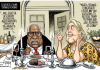



Wilhoit’s law.
Conservatism consists of exactly one proposition, to wit: There must be in-groups whom the law protects but does not bind, alongside out-groups whom the law binds but does not protect.
Exhibit A.
Yes. That’s it exactly.
I think SDB must stand for Sneaky Damned Bastard. AKA Elon Musk!
We’re all left wondering what kind of brain disease leads someone to “think” the way Musk and all the zillionaires do. Clearly that disease first kills all empathy, which leads directly to a lifelong inability to feel sympathy or to love. After that, there’s not much left to take from life except money.