
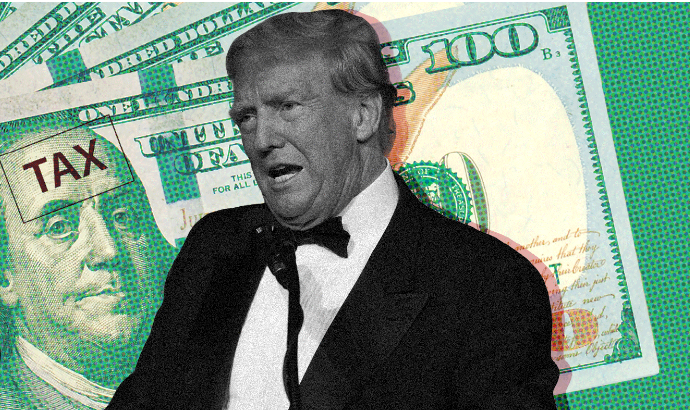
We have said it and said it and said it. Going back to the election now, we – I along with the loyal readers of this column – have discussed the primacy of the economy, the fickle nature of the American voter regarding their money, the blame the politician gets, and how Trump’s actions and promises predictably invite economic fear and stagnation. Not that any of it is exotic or next-level analysis. Real economics is very hard. This is just real reality, and this is easy. The more scared the American, the less they spend, the more things cost, the worse the economy, the worse it gets for the politicians, mix and repeat. Not hard at all. Which is what makes it so predictable. That first step? The more scared the American? Trump is doing all he can do to scare Americans – badly. Sure, it’s part of every campaign. He had to talk about the economy in dour terms. But he won and he’s still talking about the stuff he’ll do to invite instability, and thus invite problems. Now we see the inevitable. He has been in office one month and looking back one month we see the result – it’s not a coincidence. Consumer confidence is down as sharply as at any point since COVID.
Yes, going back to about the time of the Delta variant (If I recall correctly). And so the conditions must remind voters of something as bad as existed around COVID. We recall what existed back then. Inflation. And guess what? It is back. From a report by Reuters:
Huh wonder if this had anything to do with November December and January the incoming prez spending all day talking abt massive tariffs and various ways to turn the economy upside?
— Josh Marshall (@joshtpm.bsky.social) 2025-02-25T20:10:09.094Z
U.S. consumer confidence deteriorated at its sharpest pace in 3-1/2 years in February while 12-month inflation expectations surged, offering further signs that Americans were growing anxious about the potential negative economic impact of the policies of President Donald Trump’s administration.
The Conference Board survey on Tuesday noted that “comments on the current administration and its policies dominated the responses.” It followed on the heels of surveys last week showing steep declines in business and consumer sentiment in February. Tariffs on imports, which Trump has already imposed or is planning to, have been singled out as the major issue in almost every survey of households and businesses.
It is almost enough to make one wonder why they even bothered taking a formal poll. Yes, they needed the official numbers (It could have been even worse, one supposes), and yet this result and the comments above were nearly automatic. It has been a long long time since the U.S. has put blanket tariffs on imports. No one really knows what they will do except make things more expensive. They are a tax. But tariffs aren’t the only issue:
“Americans are increasingly pessimistic about the outlook. No Federal government has ever before threatened government workers with mass firings and it is starting to scare the daylights out of consumers,” said Christopher Rupkey, chief economist at FWDBONDS. “The economy could well ground to a halt in the first quarter of the year as consumers stay home.”
Unlike the impact of talking tariffs, very few of us saw the terminations coming, not at this level. Once the federal cuts began it was easy to foresee the impact on employees generally. It makes everyone consider how vulnerable they are to one major change in their lives. Half of all Americans are only 30-90 days from homelessness at any one point in their lives. It need only take the loss of a job, a major medical problem keeping one from work, perhaps a divorce and sudden loss in partnership income. We are vulnerable. Hearing about mass terminations makes people realize just how much so and they act accordingly.
It is stunning that something as important as economic growth comes down to nothing more than the group’s mood. Sure, supply, demand, interest rates, and labor, along with the environment, taxes, all have tremendous impact. But when everything else stays the same, it comes down to the people’s moods. You would think that an administration would be more cautious regarding those messages.
Right now, the mood is very dour. I don’t see a thing on the horizon that might improve stuff. Indeed, I see increased reason for worry. Fortunately, it makes Trump less politically popular, thereby cutting into his impact. Unfortunately, we have to experience the pain along with everyone else to get there.
God Bless: I can be reached at [email protected] and on Twitter-X at @JasonMiciak and please follow me on Bluesky.
Friends, we are struggling to make ends meet. It’s not just us, it’s industry wide. There are star hosts being bumped on MSNBC as we speak. (Joy Reid and Alex Wagner) So if you can afford a small donation or a monthly subscription, it would be greatly appreciated. Thank you. Ursula












I am at a loss to understand why people are upset when a political party has long said ‘Government doesn’t work’ would get voted in and introduce measures to ensure it doesn’t.
You voted for it, you got it.
Maybe now people are realizing government DOES work.
For them.
It’s simple: the average American is a selfish racist moron. I remember the grey haired tea party railing against the federal government while receiving social security, Medicare, medicaid, etc…phucking hypocrites and morons. The best explanation I’ve seen is: the folks who voted for Trump thought he’d hurt other people, not them. The rest of us voted against him because WE KNEW he’d hurt us and everyone else. It appears we are a culture destined to learn the hard way, if, IF we smarten up at all.
Talk about pronouns. I really don’t understand this use of “we” any more, especially when you’ve just said ” the folks who voted for Trump thought he’d hurt other people, not them. The rest of us voted against him because WE KNEW he’d hurt us and everyone else.”
“We are a culture destined to learn the hard way, if, IF we smarten up at all.”
This “culture” is so polarized the word “we” simply doesn’t apply when I’m talking about myself, my family or anybody I identify with.
Exactly!
It is not wealth, but the USE of wealth or “wealth” (most of us aren’t rich but still spend money on everyday goods and services each month) that makes any economy strong and healthy. More U.S. wealth is concentrated in fewer hand than at any point in our history. Worse, that relative handful of people with all that wealth want MORE! Hence the last four decades of trickle down economics and now the uber wealthy want ANOTHER round of wealth transfer via a big tax cut geared towards them!
However, there’s only so many luxury jets and extra homes they can buy, or trips to exclusive resorts. MOST of their money just sits in their bank accounts instead of circulating through the regular economy. Buying the stuff almost all regular Americans buy, and then being recirculated by those who sell them the goods and services they need for basic living. So, when people get scared they cut back their own spending. Even on items they need like new clothing, or a new computer or car or repairs on their house and so on. IF they can sock away any money it will sit there in the bank instead of being spent. Less money circulating in communities means less people working and getting paid. People have no choice but to buy food. Other things? They will put off any and everything they can.
Cuttbacks in spending starting at the community level will quickly filter UP and slow down the entire economy.