
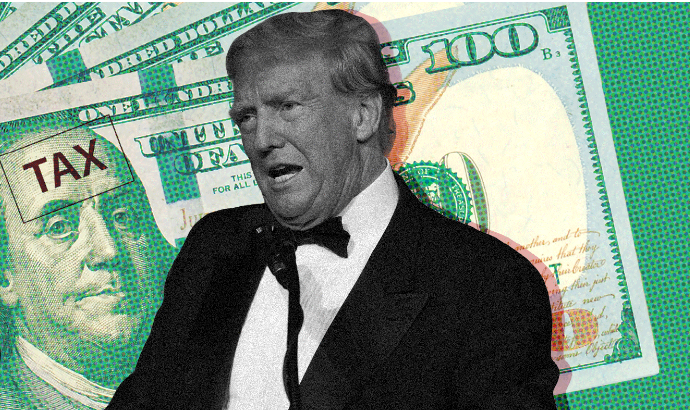
Big corporations and big banks have to think one to five years in advance at any one time, airlines hedge by buying future fuel contracts – it is hard to forecast future market conditions. It is hard enough during normal times, but it can be utterly impossible when chaos is suddenly thrown into the system as we now see happening with Trump’s latest moves to impose blanket tariffs on Canada, Mexico, and China (But not Russia, not Saudi Arabia, not yet anyway). To say that markets haven’t been impressed is to taunt the meaning of “understatement.” These tariffs have introduced instability in a dynamic that had been enviably reliable – a poison for business.
From The Independent, we have an assessment of the value of this type of tariff as quoted from The Wall Street Journal.
Canada and Mexico have already hit back at the tariffs, triggering what an editorial by the Wall Street Journal has called “the dumbest trade war in history”. Both countries have now moved to introduce counter-tariffs against the US, as all three of the largest North American countries see their economies hit.
And the results are beginning to trickle in as we see markets tumble overnight. This isn’t something over which anyone ought to enjoy some schadenfreude over failing Trump policies. No, these results below form the underpinnings of global recessions – or, at least, stagnation.
As reported by the paper of record, things didn’t go well overnight. Give it to us, Mother Times:
Japan’s Nikkei 225 index and South Korea’s Kospi each fell more than 2.5 percent. The Taiwan Stock Exchange weighted index slumped 3.5 percent. Markets in mainland China were closed on Monday for the Lunar New Year holiday. Stocks in Hong Kong, where many Chinese companies trade, dipped slightly.
Wow, quite the line-up. I mean, the ’76 Steelers couldn’t go down the line like “Japan, South Korea, Taiwan… With China closed for a holiday” and losses between 2.5-3.0% – those are significant, they are in direct response, and maybe just the beginning. Those are big trading partners. Economies that struggle there cause economic trouble here.
Europe’s stock indexes also tumbled. The Euro Stoxx 50, made up of the region’s largest companies, dropped 2 percent and the FTSE 100 in Britain declined 1.3 percent. In the United States, S&P 500 futures slid 1.5 percent.
Well, at least they’re less than two – though the day wasn’t done yet. Additionally, Europe is more insulated from China than the Eastern countries listed above. But these things ripple.
So we see the impact already and the instability is just beginning. After all, companies haven’t really had time to make major product adjustments. More importantly, consumers haven’t felt the teeth of these tariffs – consumers are the ones who ultimately pay the price, always do.
Too bad. Some tariffs can do a lot of good. If your crappy country’s government is subsidizing its lumber industry, a good tariff on lumber, is what you deserve. Throwing in blanket tariffs because you don’t like the border policy or, well – don’t like China, is a way to make the future even foggier. When big companies can’t see through the fog, they hold their money tightly, and – well, markets don’t like that.
One can debate all day whether full free trade is an irrefutable good but one cannot debate that the system had been more predictable and that predictability allowed you to buy massive televisions for $500… Are Americans ready to pay $750 for the same product to influence Chinese policy? History says “No.”
Americans like nice things and they like them at very low prices. It would seem that the markets believe that Americans and others won’t be “buying as much stuff” as things get more expensive in a trade war. The drop in indexes was almost as predictable as free trade itself.
God Bless: I can be reached at [email protected] and on “X” @JasonMiciak and now on Blue Sky.








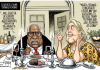









I had hoped that once rich people were impacted, they would do something to reign in this fool, but then I heard a bunch of them were shorting stocks, so this is a good thing for them. Bastards!
“I had hoped that once rich people were impacted, they would do something to reign in this fool,” Exactly why trickle down economics don’t work: Using the $500/$750 TV example above. The $250 rise is bone crunching for lower incomes; a problem for, say, $75k, a blip for, say, $100k or so. For Cabinet members? They make that $250 without a monent’s thought. Instead of the TV, think of the reputed $1200+ cost of tariffs. The pips will squeak. But if they do so in concert, will Congress members hear? and respond? Reining in the fool as you desire?