
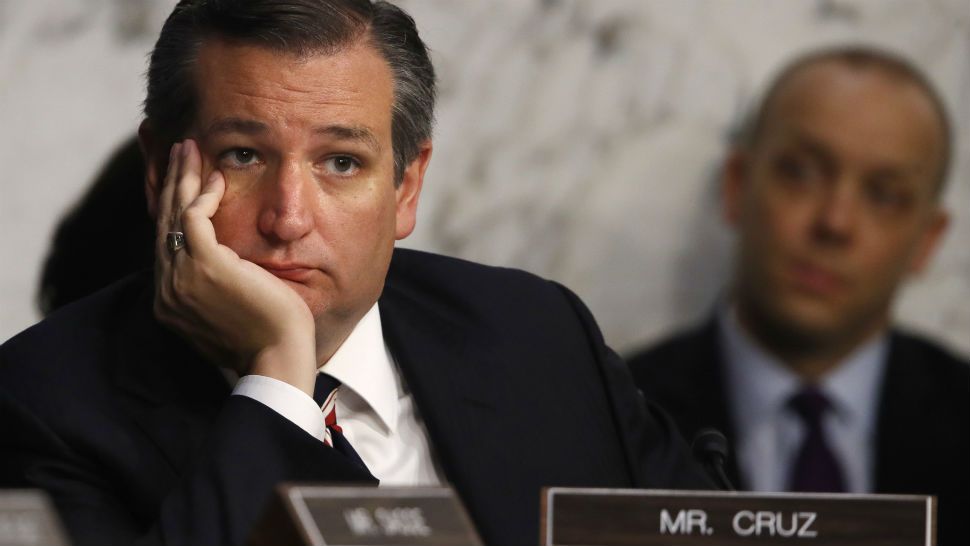
Senator Ted Cruz enjoys the unique reputation as being one of the very few true nonpartisans in Washington, nearly everyone loathes him without respect to party affiliation or branch of government – the guy is a legend. But that doesn’t mean he isn’t useful to the Republicans on highly partisan issues, to wit – cabinet nominations have moved from being a rather mundane once-over in the Senate to the point where it is near vote for vote down party lines – nearly. Pure partisanship was the play even before President-elect Donald Trump began naming his new clutch, one that includes the increasingly reprehensible Peter Hegseth as nominee for Secretary of Defense. Cruz implies he will vote for Hegseth unless he is found to be straight out of a horror movie. Except, he is.
Indeed, there are very strong allegations that Hegseth did do something highly disqualifying akin to a murder. But Cruz implies that he’s going to skip right over the sexual assault settlement that is established fact, along with Hegseth’s notorious drinking problems. These two characteristics come in even before acknowledging that Hegseth is nowhere near qualified as compared to previous Defense Secretaries, including Donald Trump’s previous appointments.
Thus it was that CNN’s Kaitlin Collins put Cruz through the ringer on Tuesday night, asking if there was anything that Cruz might find as prohibitive with respect to a cabinet position generally and Hegseth in particular. Friends at Rawstory bring us the transcripts.
“Well sure. If he, you know, killed someone and dragged their body into the woods, I’d vote no. I don’t believe that’s going to be the answer.”
Collins smartly pointed out that ax murderering isn’t exactly the standard for Secretary of Defense. After all, everyone has the right to be free from prison until a jury finds them guilty beyond a reasonable doubt. No one has the right to sit in the cabinet above entire executive departments. Collins shot back, “But that’s not your standard for confirming a defense secretary?
Cruz lifted himself off the mat, probably realizing that he had just pinned himself:
“Of course not, I picked an absurd example. But yes, of course, with any nominee, if something comes out about them that nobody knows that is deeply concerning, everyone will – that’s why you have advice and consent because you discover things about people’s backgrounds.”
Except I picked an extreme example as well. While comprehensively intoxicated, Hegseth sexually assaulted a married woman in a hotel room and the situation was such that he paid the woman a settlement figure in order to buy her silence. He was purportedly worried about losing his job at Fox News, now he is applying for a job as Secretary of Defense and Cruz thinks that murderers are somehow less qualified than drunk rapists. Even without the rape – which shouldn’t be thrown out, given the police report and seriousness of the underlying conduct – Hegseth’s well-established drinking problem. In 1989, the Senate rejected fellow Senator John Tower due to his reputation for alcoholism and “womanizing.” Hegseth would seem to fall into the same category even absent the rape. And Tower had more political experience.
Cruz cried that the Senate has a mere “review” of nominees and is there primarily to put the new president’s choices in place:
“I think most Republican senators begin from a proposition that the president is entitled to choose his cabinet nominees,”
Collins had done her homework because she put the standard right back in Cruz’s lap by noting that Cruz had voted against every single Biden pick with the exception of Defense Secretary Lloyd Austin – a former four-star general. Cruz had his defense, anemic as it was.
“But look, I mean, a lot of Biden’s picks, I think were extreme. You look at someone like Merrick Garland. I think Merrick Garland has been the most partisan and political attorney general the country has ever seen.”
Let’s actually play along and say that Merrick Garland did act as an extreme partisan – not conceding such, just playing. Garland had a career at the Justice Department before taking the bench, then serving as a 23-year veteran of the DC Circuit Court of Appeals. He was known as such a moderate that President Barack Obama picked him to fill Anthony Scalia’s seat. Even accepting Cruz’s premise that Garland turn out partisan (Which we don’t), there was no indication at the time of his confirmation – his defining reputation was as a moderate.
If you look at other cabinet positions on which Cruz voted “No,” you find Secretary Anthony Blinken, a former deputy Secretary of State and national security advisor. Move on to Janet Yeliln, who served as Chairwoman of the Board of Governors of the Federal Reserve System. Pete Buttigieg – no flamethrower there. These are not “extreme” nominees, not in any light and especially not in comparison to Trump’s nominees, nor the position in which they served.
Cruz then said that Trump had named many moderates and included Tulsi Gabbard and Robert F. Kennedy “as examples who were Democrats “until like 12 minutes ago,” Say what one wants about Gabbard and Kennedy – “moderate” doesn’t quickly come to mind. Additionally, neither is in a position to let any moderation fly. Gabbard is an extreme Russophile and will be handling the nation’s tightest secrets while RFK Jr. is an extreme “alternative medicine” guy (To put it with extreme understatement), both of whom do not bring moderate views to their job.
Back to Hegseth. Play along. What if Hegseth’s nomination had been debated back and forth between alcoholism – untreated (we absolutely support people in recovery as fully capable as anyone) along with Hegseth’s inexperience relative to the position? What if amidst that backdrop came the rape allegation? What if it registered as a complete surprise in late December? Is that not almost identical to Cruz’s example? Does anyone think that raping a woman in a hotel room is somehow far below that of murder? Doubtful – or, at least, it shouldn’t be. It seems obvious that if the rape allegation sprung as a surprise in late December, that would scuttle his nomination without a murder alongside.
And yet Cruz seems to be demanding that someone find just that – a murder in Hegseth’s background, to disqualify him. In effect, they have found a body, one thoroughly violated and belonging to a person very much carrying the scars, and the allegation is going largely ignored. This is on top of Hegseth’s other issues, one of which is that he just so obviously lacks the requisite experience one expects from a Secretary of Defense.
Ted can be counted on to stand out as someone beguilingly non-partisan in persona. He is not loved in the Senate and that goes for blue or red. But on this, he “embodies” the current Republican thinking with respect to Hegseth. It is really difficult to accept given that one senses that the Republicans generally wish that Trump had made their jobs just a little easier by picking people who were a bit more mainstream and less troubled. Be that as it may, one can count on the vast majority of them voting “Yes,” and that is with or without a dead body dragged behind.
God Bless: I can be reached at [email protected] and on X at @JasonMiciak and now on Bluesky – follow me there.






















So, Jason, here’s a new Hegseth story that popped up this morning and I wonder if he will be sorry he’s making it a big deal. ProPublica was looking into Hegseth’s claim he was admitted to West Point. PP was going to print that Hegseth was NOT admitted because that is what West Point told them. After some back and forth with lawyers and West Point, ProPublica killed the story because West Point apologized and said Hegseth received an acceptance letter in 2003. Hegseth is now loudly talking about a media hit piece even though there isn’t one because it was killed and he knows it.
For me, two questions remain. #1–does an acceptance letter equal admittance, which Hegseth claims? If you get a letter and did not go any further in the process, is it an honest claim that you were “admitted?” #2–although there could be any number of things (family death, serious illness, money issues) that keep you from attending a school, I’m now very interested in why Hegseth went through the difficult acceptance process yet did not go. Is it a simple story or something he wouldn’t want to shine a light on? If I were a reporter or a Senator, I would certainly ask for clarification.
How about, just to PAD his Resume?